Explore Our Current Lineup
The following are the latest resources to help you with your leadership, investigations and officer development.
Popular
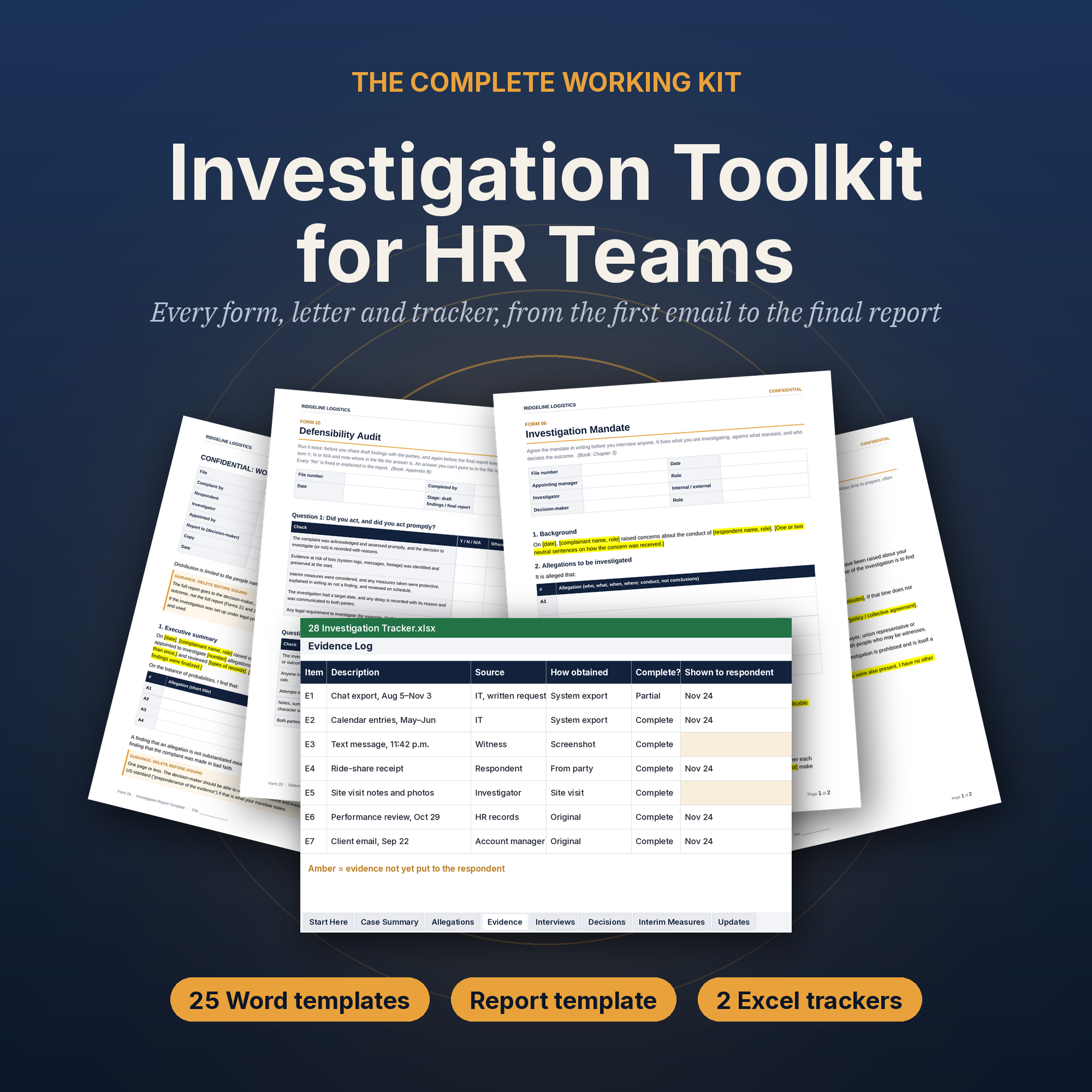
INVESTIGATION TOOLKIT FOR HR TEAMS
Every form, letter and tracker for a fair, defensible workplace investigation, from the first email to the final report.
You've read the method. Now run it the same way, every time.
When a harassment or misconduct complaint is challenged, reviewers don't just read your findings. They read your file: the mandate, the notices, the interview records, the evidence log, the decisions you made and why. Gaps in the file are where investigations fall apart.
The Investigation Toolkit for HR Teams gives you that whole file, ready to brand and use. It's the complete working kit for The HR Investigator's Interview Guide by Paul Clarke, built so your team can run every investigation the same way, step by step.
WHAT'S INCLUDED
25 editable Word templates, in the order you'll use them
Intake and set-up
• Quick Start Checklist
• Conflict of Interest Screen and Declaration
• Assumptions Log
• Intake Checklist and Notes
• Acknowledgement Letter to Complainant
• Investigation Mandate (with amendment log)
• Allegation Map
• Preservation Request to IT
• Interim Measures Letter
• Notice to the Respondent (with schedule of allegations)
• Investigation Plan Interviews
• Invitation to a Witness
• Status Update Letter
• Interview Scripts (opening, account, sensitive questions, putting evidence, distress, reluctant witnesses, confidentiality, closing)
• Question Bank, including "avoid this, ask this instead"
• Interview Record
• Evidence Log
• Decision Log
Findings
• Credibility Worksheet
• Defensibility Audit
After the report
• Outcome Letter to Complainant
• Outcome Letter to Respondent
• Witness Close-Out Note
• Retaliation Monitoring Plan
Outside help
• External Investigator Engagement Checklist
A full investigation report template, with guidance notes
A ten-section report structure with a guidance note in every section explaining what reviewers look for. It includes an allegation-by-allegation block, a policy elements table, standard finding categories, schedules for interviews, evidence and chronology, and a final consistency check. Delete the guidance notes and the report is ready to issue.
Plus the Evidence Summary for Response letter, which gives each party the evidence relied on before findings are final.
Two Excel trackers
• Investigation Tracker (one per case): allegation map, evidence log, interviews, decisions, interim measures and party updates in one workbook. The Case Summary shows days open, days to your target date, overdue interim reviews, evidence not yet put to the respondent, and when the next party update is due.
• Team Case Register: one register and dashboard for every investigation your team runs.
BUILT FOR REAL USE
• Brand it once. Add your organization's name or logo to the header and save your own master copies.
• Fill in, don't start from scratch. Letters are pre-written in plain language. Every detail to replace is highlighted, so nothing gets missed.
• Every form shows its book chapter, so you can check the reasoning behind each step.
• Canada and the US. Wording and guidance cover both, including standards of proof and confidentiality instructions.
• Print-ready. Every template prints cleanly on letter paper.
WHO IT'S FOR
HR generalists and managers, employee relations specialists, people leaders who have been asked to investigate, and HR teams that want one consistent process for every investigator.
CHOOSE YOUR LICENCE
Individual license: for one investigator's use within their organization.
Team license: for everyone who conducts or supports investigations within one organization. (email for pricing)
Instant download: one zip file with a Start Here guide, 27 Word documents and 2 Excel workbooks.
FREQUENTLY ASKED QUESTIONS
Do I need the book?
The toolkit works on its own, and every form explains its purpose. The book explains the method behind each form in depth, with a full worked case and court decisions that show what reviewers look for. The two work best together.
How is this different from the free toolkit?
The free toolkit is a fillable PDF of 10 core forms and the Quick Start checklist. This toolkit gives you editable Word versions you can brand, 15 additional forms and letters covering the whole investigation, the full report template, and the trackers.
Can I change the templates?
Yes. Edit, brand and adapt them for investigations in your own organization. Please don't resell or share them outside your organization.
Is this legal advice?
No. These are general tools. Laws, policies and collective agreements differ by province and state and change over time. Adapt the templates to your situation and get advice from a qualified lawyer in your jurisdiction before relying on them in a specific case.
Stop "Winging It." Start Closing the Gap.
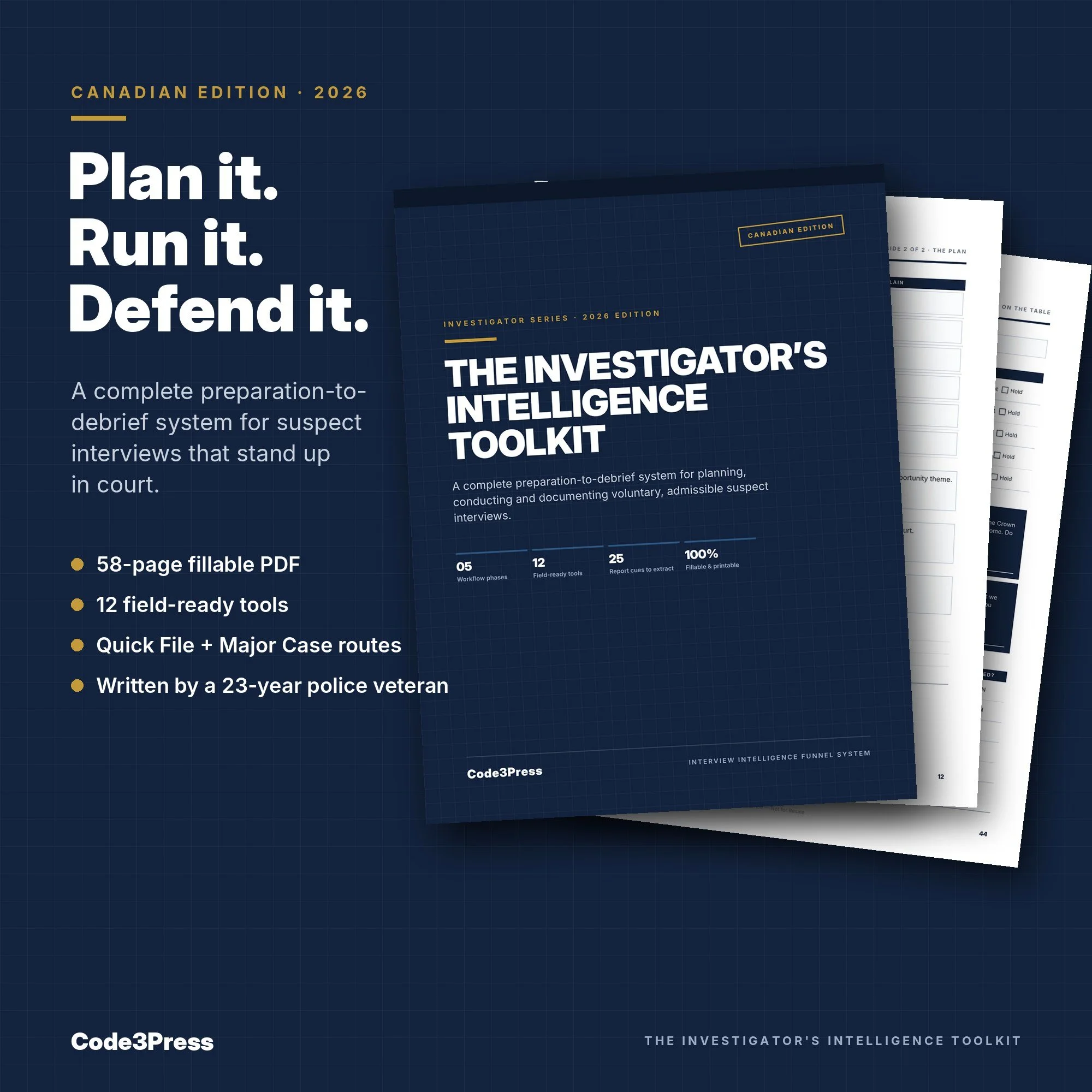
The Investigator’s Intelligence Toolkit
Plan it. Run it. Defend it.
A complete preparation-to-debrief system for suspect interviews, built on Canadian law.
Most interviews are won or lost before you walk into the room. Yet most investigators still plan on a blank notepad, or not at all. The result is predictable: themes made up on the spot, evidence revealed in the wrong order, a denial you didn’t see coming, and an admission the defence spends a full day attacking at the voir dire.
The Investigator’s Intelligence Toolkit replaces guesswork with a structured, evidence-based process. You start with the raw file and finish with a clear interview plan, a clean record in the room, and a statement that has the best possible chance of being ruled voluntary and admissible.
Two routes: match the effort to the file
Not every file needs a full workup.
Quick File: four pages for straightforward files such as theft under, mischief, simple assault or breach. One double-sided sheet to plan at your desk, and one to take into the room.
Major Case: the full five-phase system for serious, complex or high-risk files.
If a simple file turns complicated part-way through, switch to Major Case. Everything you’ve already typed carries over.
Type it once. It fills everywhere.
The case number, subject, evidence order, themes, opening statement and likely denial are linked across all 12 tools. Enter them once while planning, and they’re already on your In-Room Sheet when you sit down.
One sheet on the table
The two-sided In-Room Sheet is the only thing you bring in. It holds:
the 12 interview phases, with time codes
your planned evidence order, with a column for the subject’s response
a denial tracker
a voluntariness log (breaks, water, washroom, assertions of silence)
scripted legal firewalls for after an admission
Built on Canadian law
Every legal step is mapped to the case law that governs it: Oickle (voluntariness), Singh (right to silence), Sinclair (re-consulting counsel), Suberu (rights on detention), Tessier (cautioning suspects) and Stinchcombe (disclosure).
A dedicated “Write for the Stand” section shows you how to complete every sheet so it holds up when defence counsel reads it aloud in court.
What’s inside
Phase 1: Case Analysis
Investigative Blueprint: mine police reports for timeline anchors, behaviour and history
Interview Cue Extraction Checklist: 25 critical cues no file review should miss
Case File Preparation Checklists: file review, video timeline, injuries and contradictions
Phase 2: Strategy Design
Interview Intelligence Funnel: rank your evidence, forecast the denial, plan the opening
Guilty Knowledge Filter: lock down the non-public facts you’ll hold back
Theme Development Templates: identity, emotional and future-consequence themes, each tested against legal guardrails
Phase 3: Legal & Environment
Legal Reference Sheets: Charter duties, the Oickle factors and common pitfalls
Interview Room Setup & Positioning Guide: layout, a clean table and recording checks
Phase 4: In-Room Execution
In-Room Interview Sheet, plus the extended worksheets for major cases: rapport prompts, denial mapping and admission-consolidation scripts
Phase 5: Review & Debrief
Post-Interview Review & Reflection: confirm the record held, and capture the lesson for next time
Plus: a one-page Interview Day Quick Reference card, a glossary, and a step-by-step workflow guide.
Who it’s for
General investigators and detectives
Patrol officers taking statements on their own files
New investigators building good habits early
Supervisors and trainers who want a consistent standard across a unit
Corporate and loss-prevention investigators. The legal sections are Canadian, so if you work under another system you’ll need to adapt them.
Format
58-page fillable PDF. Type directly into it in Adobe Acrobat Reader (free), or print it.
Letter size, ready to print double-sided
Start each case by saving a fresh copy, so your blank master stays clean
Written by working police
Developed by Paul Clarke, a 23-year law enforcement veteran and field training officer, to bring structure, consistency and legal discipline to interview preparation.
Licence
Single-user licence: one investigator, unlimited cases. Team and agency licences are available. Contact Code3Press.
This toolkit is an educational and organizational resource. It isn’t legal advice and doesn’t replace your agency’s policy or the advice of Crown counsel. Case law evolves, so confirm currency with your agency.

What This Is
Foundations is where the whole Interview Room Series starts: the science of memory and the cognitive interview, turned into fillable tools you actually use before, during, and after a witness or victim interview.
This is the standalone digital toolkit for Book One — seven interactive tools that live in a single file on your own computer. No app, no login, no subscription. Open it, fill it in, and it remembers everything for you.
If you've read Foundations, this is the working companion that turns what you learned into what you do. If you haven't read it yet, every tool includes enough context to use it well on its own.
How It Works
This is one self-contained file — the same kind of file your browser opens every time you visit a website, except this one lives entirely on your machine.
Open it like any document. Double-click it. It opens in Chrome, Edge, Firefox, or Safari — no installation, no account.
Your data never leaves your computer. Everything you type is saved directly to your own browser, on your own device. Nothing is uploaded, nothing sits on a server.
It works with no internet connection, once downloaded — at your desk, in a vehicle, anywhere.
It autosaves as you type. No save button to remember, nothing lost if you close the tab.
You can export a backup or print any tool — clean, field-ready printouts, or a portable file you can back up and carry to another device.
The 7 Tools Inside
Pre-Interview Preparation Checklist — case familiarization, understanding the witness, objectives, logistics, and risk/safety considerations, confirmed before you ever sit down.
Context Reinstatement & Free Recall Delivery Checklist — walk a witness back into the state where memory actually surfaces.
Reverse Order Recall Segmenting Worksheet — break an event into segments and work them out of sequence, where the cognitive interview does its real work.
Notetaking Template & Standards Card — a consistent record every time, built to hold up later.
The Cognitive Interview Structural Template — the full interview, phase by phase, so nothing gets skipped under time pressure.
Generic Question Bank & Quick Pull Card — open-ended prompts on hand for the moment you need them, not reconstructed from memory.
Field Exercise Worksheet Pack — practice scenarios to run the technique before it matters.
Why It's Worth Owning on Its Own
A consistent starting point, every time. The cognitive interview only works if the structure holds up under pressure — a step skipped because it's the fifth interview that week is exactly the gap a defense lawyer looks for. This toolkit makes the process repeatable instead of memorized.
Built for the interview you're actually doing. Foundations is written for victim and witness interviews — memory-first, rapport-first. If your caseload is mostly that kind of interview, this book's toolkit may be all you need.
No data storage headache. Everything stays local. Nothing about a witness or a case touches a third-party server.
A low-cost way to try the series. If you're not ready for the full four-book toolkit, this is the place to start — and if you decide you want the rest later, upgrading to the complete toolkit is always an option.
Foundations — Digital Toolkit is Book One of The Interview Room Series, published by Code3Press.
The moment a grievance gets filed, everything you said — and didn't document — gets scrutinized.
When an arbitrator asks what you told the member, when you addressed the issue, and what they agreed to — you need more than memory. You need a paper trail that was built from day one.
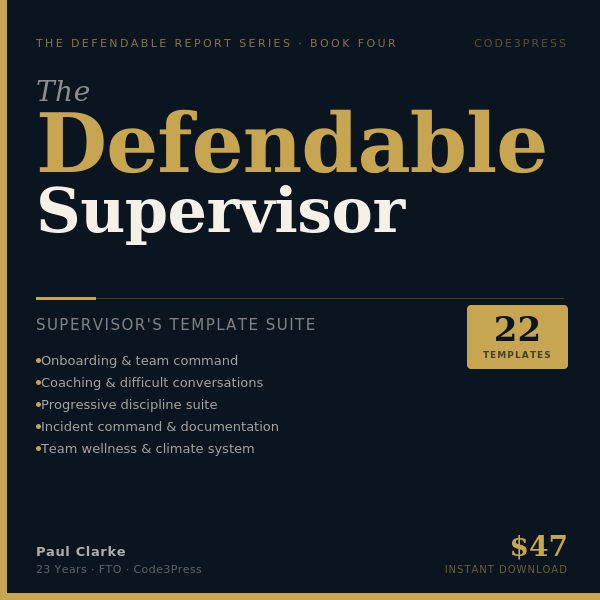
The Defendable Supervisor Template Suite gives you that system. 22 field-ready, fully editable templates covering every major supervisory situation — from the first onboarding conversation through a critical incident command post.
WHAT'S INCLUDED — 22 TEMPLATES ACROSS 6 SUPERVISORY SYSTEMS
(Part One is covered in "The Defendable Supervisor" Book available on Amazon)
Part Two — The Relationship Shift
01 · Member Onboarding Profile — structured baseline record for every team member
02 · Onboarding Conversation Question Guide — nine-question framework for the first meeting
Part Three — Taking Command
03 · Team Expectations Framework — set the standard before you need to enforce it
04 · Team Meeting Agenda and Documentation Template
05 · Individual Onboarding Meeting Log
06 · Weekly One-on-One Tracker
07 · 2IC Briefing Checklist
Part Four — The Defendable Conversation
08 · Coaching Log — document every coaching moment in real time
09 · Feedback Conversation Planning Guide — structure feedback before you deliver it
10 · Difficult Conversation Planning Guide — prepare for the conversation you're dreading
11 · Post-Conversation Documentation Template — record what was said and agreed
Part Five — The Defendable Record
12 · Administrative Notebook Entry Standard
13 · Email Summary Template
14 · Progressive Discipline Tracking Log
15 · Letter of Expectation
16 · Disciplinary Checklist
17 · After-Action Debrief Template
18 · Critical Incident Documentation Checklist
Part Six — The Defendable Team
19 · Monthly Team Climate Check-In Guide
20 · Individual Check-In Guide
21 · Officer Wellness Observation Log
Part Seven — The Defendable Incident
22 · Critical Incident Command Checklist
22b · Laminate Duty Card Version (print, cut, carry in your duty notebook)
THREE WAYS TO USE THESE TEMPLATES
Print and use today. Every template is formatted for 8.5×11. Print what you need, start building your documentation from your next shift.
Adapt to your team. The templates are fully editable Word files. Add your agency logo, adjust field names, modify structure — keep the framework, make it yours.
Use as a training resource. The conversation planning guides and documentation standards work as supervisory development tools. Walk through them before the situation that requires them arrives.
WHO THIS IS FOR
→ Newly promoted sergeants and corporals stepping into their first posting → Supervisors facing a grievance, appeal, or discipline review → Field training officers building a consistent documentation system → Agencies standardizing supervisory documentation service-wide → Any supervisor who wants their decisions to hold up under scrutiny
ABOUT THE AUTHOR
Paul Clarke is a 23-year law enforcement veteran, certified critical incident debrief facilitator, and field training officer. He is the author of The Defendable Report Series — a practical documentation library for law enforcement professionals. This template suite is the operational companion to Book Four: The Defendable Supervisor.
Published by Code3Press · code3press.com
WHAT YOU GET
✓ 22 fully editable Microsoft Word templates (.docx) ✓ Instant download — files arrive immediately after purchase ✓ 8.5×11 print-ready format ✓ Each template linked to its chapter in The Defendable Supervisor ✓ One-time purchase — no subscription, no recurring fees ✓ Dual-jurisdiction framing (Canada and US)
Department Licenses available
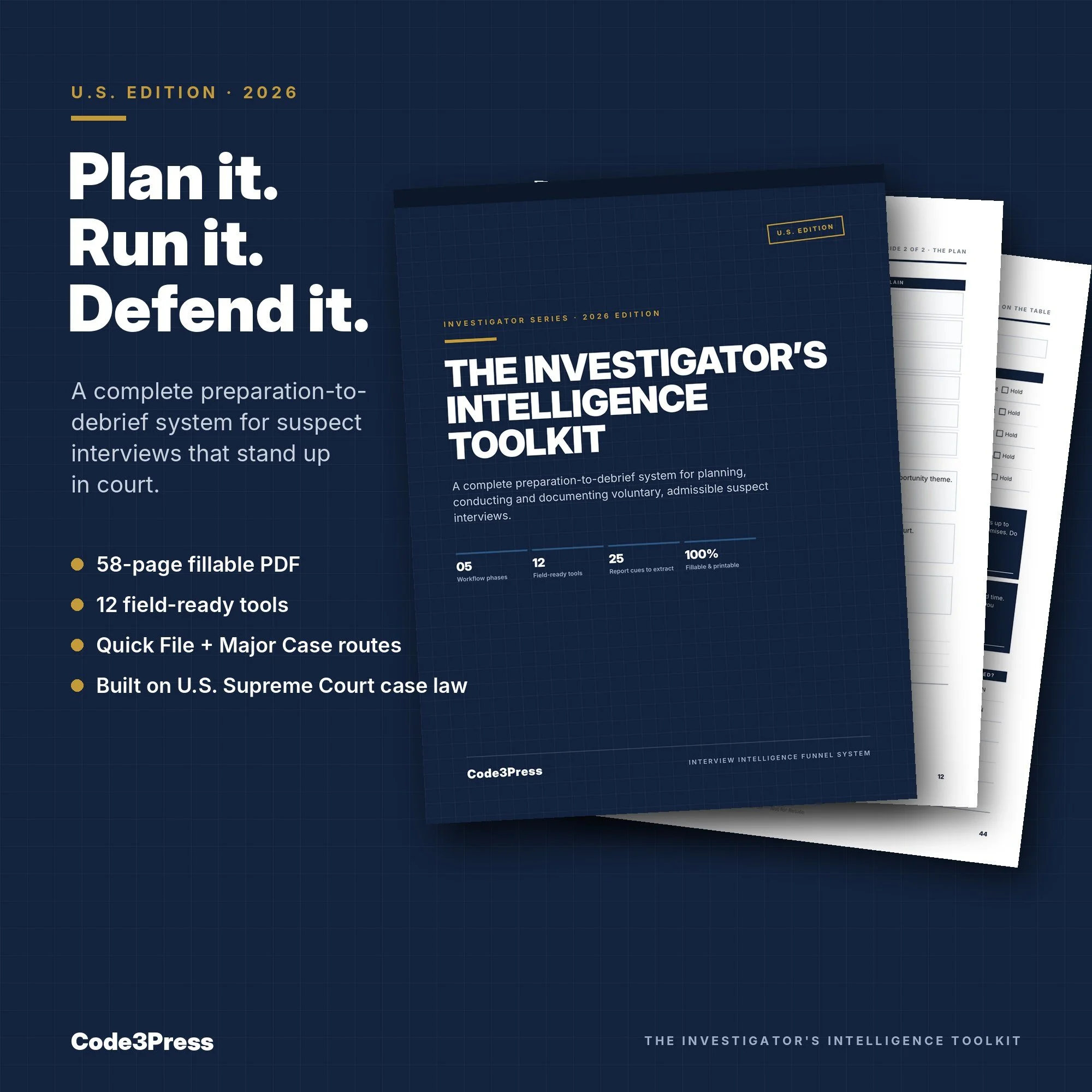
The Investigator’s Intelligence Toolkit: U.S. Edition
Plan it. Run it. Defend it.
A complete preparation-to-debrief system for suspect interviews, built on U.S. constitutional law.
Most interviews are won or lost before you walk into the room. Yet most investigators still plan on a legal pad, or not at all. The result is predictable: themes made up on the spot, evidence revealed in the wrong order, a denial you didn’t see coming, and an admission the defense spends a full day attacking at the suppression hearing.
The Investigator’s Intelligence Toolkit replaces guesswork with a structured, evidence-based process. You start with the raw case file and finish with a clear interview plan, a clean record in the room, and a statement with the best possible chance of holding up under a Miranda and voluntariness challenge.
Two routes: match the effort to the case
Not every case needs a full workup.
Quick File: four pages for straightforward cases such as petty theft, shoplifting, vandalism, simple assault or a probation violation. One double-sided sheet to plan at your desk, and one to take into the room.
Major Case: the full five-phase system for serious, complex or high-risk investigations.
If a simple case turns complicated partway through, switch to Major Case. Everything you’ve already typed carries over.
Type it once. It fills everywhere.
The case number, subject, evidence order, themes, opening statement and likely denial are linked across all 12 tools. Enter them once while planning, and they’re already on your In-Room Sheet when you sit down.
One sheet on the table
The two-sided In-Room Sheet is the only thing you bring in. It holds:
the 12 interview phases, with time codes, starting with Miranda warnings and the waiver
your planned evidence order, with a column for the subject’s response
a denial tracker
a voluntariness log (breaks, water, restroom, invocations)
the scripted voluntariness firewall
a STOP protocol for when the subject invokes silence or asks for an attorney
Built on U.S. law
Every legal step is mapped to the Supreme Court decisions that govern it:
Warnings and waiver: Miranda v. Arizona and Berghuis v. Thompkins
Invocation: Michigan v. Mosley, Edwards v. Arizona and Davis v. United States
The question-first technique: Missouri v. Seibert
Voluntariness: Colorado v. Connelly and Arizona v. Fulminante
Disclosure: Brady v. Maryland and Giglio v. United States
The toolkit flags where state law commonly adds requirements, such as mandatory recording, rules for juvenile interviews, and limits on deception, so you know what to confirm locally.
A dedicated “Write for the Stand” section shows you how to complete every sheet so it holds up when defense counsel reads it aloud in court.
What’s inside
Phase 1: Case Analysis
Investigative Blueprint: mine incident reports for timeline anchors, behavior and history
Interview Cue Extraction Checklist: 25 critical cues no case review should miss
Case File Preparation Checklists: file review, video timeline, injuries and contradictions
Phase 2: Strategy Design
Interview Intelligence Funnel: rank your evidence, forecast the denial, plan the opening
Guilty Knowledge Filter: lock down the non-public facts you’ll hold back
Theme Development Templates: identity, emotional and future-consequence themes, each tested against legal guardrails
Phase 3: Legal & Environment
Legal Reference Sheets: Miranda, the invocation rules, the Sixth Amendment, voluntariness and common pitfalls
Interview Room Setup & Positioning Guide: layout, a clean table and recording checks
Phase 4: In-Room Execution
In-Room Interview Sheet, plus the extended worksheets for major cases: rapport prompts, denial mapping and admission-consolidation scripts
Phase 5: Review & Debrief
Post-Interview Review & Reflection: confirm the record held, and capture the lesson for next time
Plus: a one-page Interview Day Quick Reference card, a glossary, and a step-by-step workflow guide.
Who it’s for
Detectives and criminal investigators
Patrol officers taking statements on their own cases
New investigators building good habits early
Sergeants and trainers who want a consistent standard across a unit
Campus, corporate and loss-prevention investigators
Format
58-page fillable PDF. Type directly into it in Adobe Acrobat Reader (free), or print it.
US Letter size, ready to print double-sided
Start each case by saving a fresh copy, so your blank master stays clean
Written by working police
Developed by Paul Clarke, a 23-year law enforcement veteran and field training officer. The interview method comes from his front-line experience. The legal content in this edition is built on U.S. Supreme Court law.
License
Single-user license: one investigator, unlimited cases. Team and agency licenses are available. Contact Code3Press.
This toolkit is an educational and organizational resource. It isn’t legal advice and doesn’t replace your agency’s policy, your state’s law, or the advice of your prosecutor or agency counsel. Confirm all legal points against your jurisdiction before use.
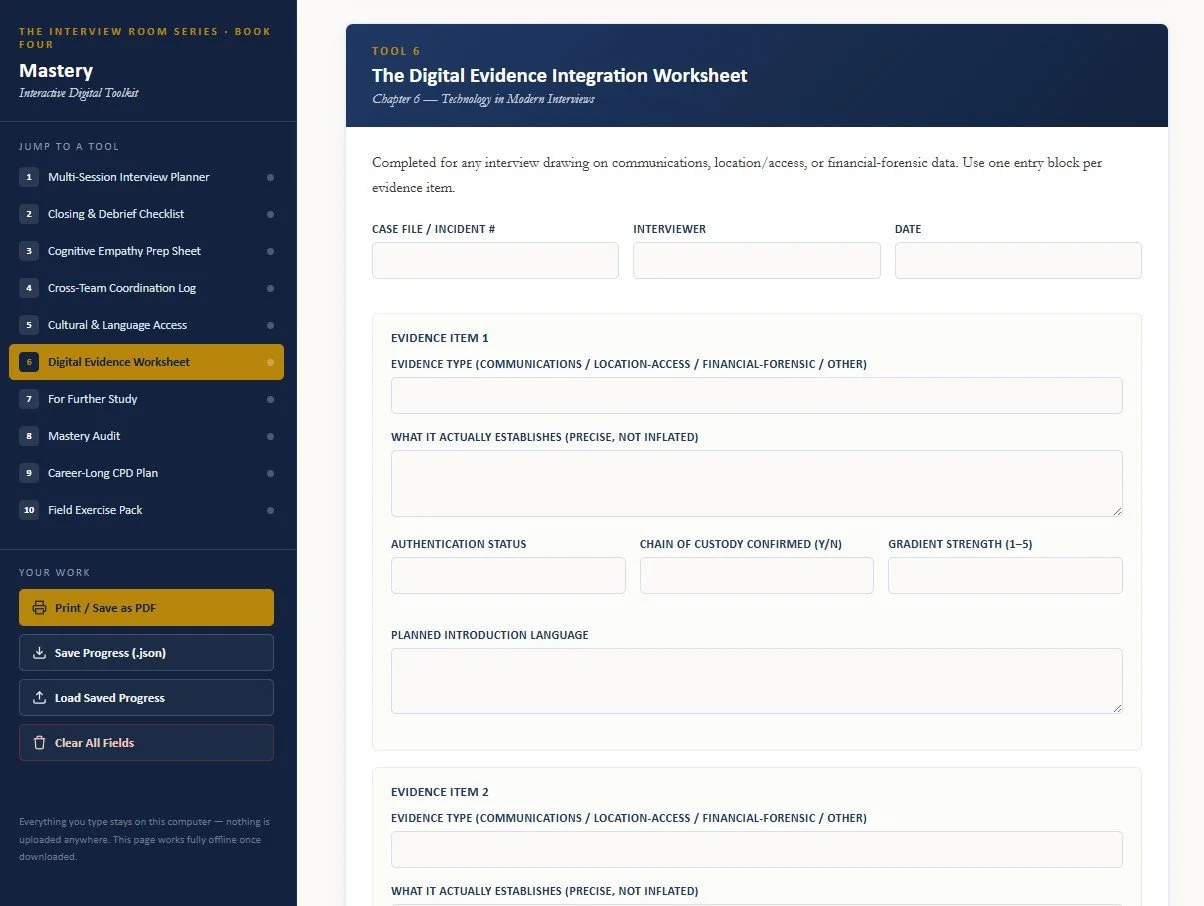
43 Field-Tested Tools. Four Books. One Interview Practice You Can Defend in Court.
What This Is
The Complete Digital Toolkit is the working companion to The Interview Room Series — every checklist, worksheet, planner, and script card from all four books, built into a single interactive file you fill in on your own computer.
This isn't a PDF you print and lose in a case file. It's not a subscription app that goes dark when the vendor shuts down or your department's IT policy changes. It's one self-contained HTML file — 43 tools, organized by book, that opens in any browser and saves your work as you type.
You already know the cost of an inconsistent interview: a missed theme, an undocumented rapport phase, a report that can't answer the defense's first question on cross. This toolkit exists so that never happens because you forgot a step — not because the step wasn't there.
How It Works (And Why That Matters)
This product is a single HTML file — the same kind of file your browser opens every time you visit a website, except this one lives entirely on your machine.
Open it like any document. Double-click the file. It opens in Chrome, Edge, Firefox, or Safari — no installation, no account, no app store.
Your data never leaves your computer. Every field you fill in is saved directly to your own browser's local storage on your own device. Nothing is uploaded, nothing sits on a server, nothing is transmitted anywhere. For officers and agencies handling sensitive investigative material, that's not a nice-to-have — it's the difference between a tool you're allowed to use and one your department's data policy forbids.
It works with no internet connection. Once you've downloaded it, the toolkit runs completely offline. Fill it in at your desk, in a vehicle, in a room with no signal — it doesn't care.
It autosaves as you type. No "Save" button to remember, no losing an hour of work because you closed the tab. Every keystroke is captured automatically, and it's still there when you reopen the file tomorrow, next week, or next case.
You can export a backup or move it to another device. Each book includes Export and Import buttons that turn your filled-in work into a portable file you control — back it up, email it to yourself, or carry it to a different computer.
You can print any tool, or the entire toolkit, in one clean pass. Every worksheet is built to print field-ready: clear labels, your answers, nothing wasted. Print a single checklist for a courtroom binder, or hit "Print Complete Toolkit" and generate the entire 43-tool series at once.
Clear, guided, impossible to get lost in. Every tool follows the same format: a labeled field, a short instruction, and a place to write. No manual required. No learning curve. You will use tool one and understand tools two through forty-three without being told how.
The Complete List: 43 Tools Across Four Books
Book One — Foundations (7 Tools)
The science of memory and the cognitive interview.
Pre-Interview Prep Checklist
Context Reinstatement Checklist
Reverse Order Recall Worksheet
Notetaking Template
Structural Template (7-Phase)
Question Bank & Quick Pull
Field Exercise Pack
Book Two — Building the Case (10 Tools)
Turning reports, statements, and background into interview themes.
Missing-Theme Diagnostic
Interview Intelligence Funnel
Police Report Mining
Statement Mining Checklist
Criminal History Pattern
Pattern-to-Theme Worksheet
Case File Prep Checklists A–D
Backgrounding Profile
Theme Development Templates
Field Exercise Pack
Book Three — The Interview Room (16 Tools)
The complete in-room playbook, victim through suspect.
Readiness Self-Assessment
Interviewer Matching Matrix
Room Setup Checklist
Rapport Entry Checklist
Genuine Urgency Quick-Check
Three-Beat Switch Builder
Memory Facilitation Log
Denial Pathway Mapping
Evidence Gradient Builder
Deflection Tactic Log
Contextual Read Checklist
Theme Progression Planner
Vulnerable Subject Checklist
Unified Blueprint
Legal Firewall Script Card
Field Exercise Pack
Book Four — Mastery (10 Tools)
Complex cases and a career of continued excellence.
Multi-Session Interview Planner
Closing & Debrief Checklist
Cognitive Empathy Prep Sheet
Cross-Team Coordination Log
Cultural & Language Access
Digital Evidence Worksheet
For Further Study
Mastery Audit
Career-Long CPD Plan
Field Exercise Pack
Why It's Worth $99
Consistency, every time, on every case. The single biggest risk in an investigative interview isn't a bad question — it's a missing step. A rapport phase skipped under time pressure. A caution not properly documented. A recall technique forgotten because the last time you used it was in a training class two years ago. This toolkit turns your process into a repeatable structure you run every single time, whether it's your first interview of the year or your five-hundredth. Consistency is what makes a body of work look professional instead of improvised — to a supervisor, to Crown counsel, to a jury.
Built for defensibility, not just documentation. Every worksheet is structured so the reasoning behind your approach is captured alongside the content of what was said — why a theme was chosen, how urgency was established, what pathway a denial took. When a defense lawyer challenges your methodology, "I always follow the same structured process, and here it is in writing" is a very different position than trying to reconstruct your thinking from memory eighteen months later.
Victim and suspect interviews, covered separately and properly. This isn't a single generic script stretched to fit every situation. Foundations and The Interview Room build the memory-focused, rapport-first approach for victims and witnesses; Building the Case and the suspect-facing tools in Book Three build the evidence-based, theme-driven approach for subjects. You get the right tool for the interview you're actually conducting.
No data storage headache. Departments are — rightly — cautious about where investigative material lives. This product was built around that reality: everything stays local to your machine, nothing touches a third-party server, and you decide what gets exported and where it goes. You get all the convenience of digital tools with none of the exposure of cloud software.
One purchase, an entire career. This isn't a single-case tool. It's a Pre-Interview Prep Checklist you'll use on Monday, a Legal Firewall Script Card you'll keep in reach for years, and a Career-Long CPD Plan built to outlast any one assignment. Compare $99 to the cost of a single afternoon of specialized training, a consultant's hourly rate, or the discovery-motion hours spent defending an interview that had no consistent structure behind it — and the toolkit isn't an expense. It's the cheapest insurance policy in your entire case file.
Genuinely easy to use — day one, no training required. No login, no manual, no learning curve steep enough to make you avoid opening it. Every one of the 43 tools follows the same clear pattern: what to do, and a clean place to do it. If you can fill out a form, you can run this toolkit at full capability the first time you open it.
The Interview Room Series — Complete Digital Toolkit is published by Code3Press.
Digital Toolkits
Filters
No results found
No results match your search. Try removing a few filters.