Investigation Toolkit for HR Investigators
Run every workplace investigation the way it will be judged: by the file.
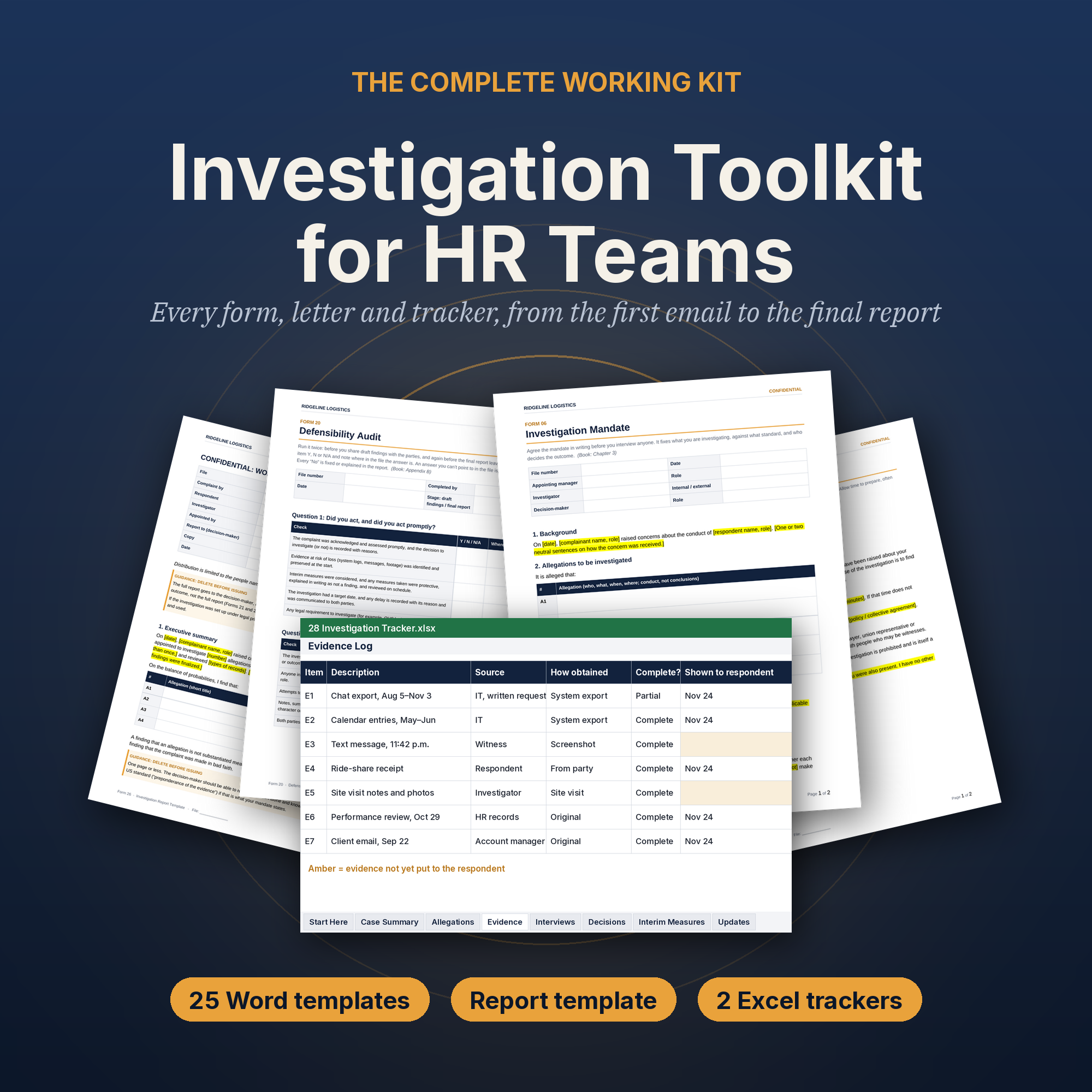
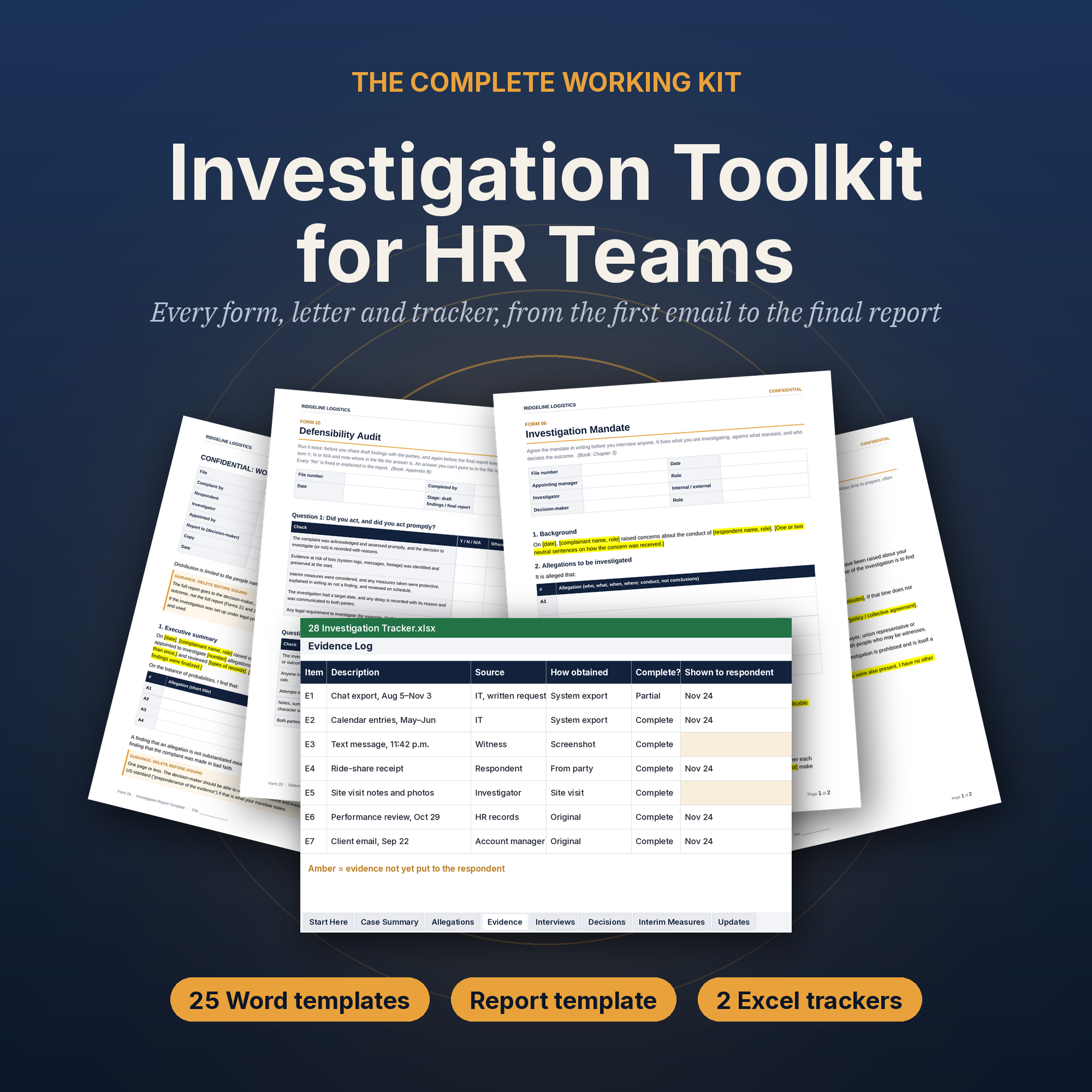
25 editable Word templates, a full report template with guidance notes, and two Excel trackers. Built by a 23-year law enforcement veteran to take your investigation from the first email to the final report, the same defensible way every time.
Instant download · Word and Excel · Canada and the US
Every investigation you run will be judged by someone who wasn't in the room.
When a harassment or misconduct complaint is challenged, a lawyer, arbitrator, tribunal or judge doesn't watch your interviews. They read your file.
They look for the mandate you were given. The notice the respondent received. Who you interviewed, and why you didn't interview someone else. Whether every piece of evidence was put to the respondent. Whether your findings follow from the evidence, allegation by allegation.
Courts in Canada and the United States have awarded significant damages not for the misconduct itself, but for the way it was investigated. Most of those investigations didn't fail because the investigator was careless. They failed because something was missing from the file, and nobody noticed until it was too late.
Many HR professionals are asked to investigate with no training, no templates and a full workload of other duties. You build each letter from scratch, keep notes in whatever format is handy, and hope you haven't missed a step.
There's a better way.
Why a police investigator's method
The discipline of a police investigation. None of the interrogation room.
Police investigators face the same problem you do: finding out what happened when people remember it differently. Policing has spent decades learning how to plan an interview, get an accurate account, record evidence properly and avoid the mistakes that sink a case.
What that means for you: every template builds those habits into the form itself. The interview record prompts you to record the opening, the questions as asked and the answers in the person's own words. The evidence tracker flags anything you haven't yet put to the respondent. The report template walks you through evidence, credibility, facts and policy, in the order reviewers expect. You don't need a police background. The forms carry it for you.
What's inside
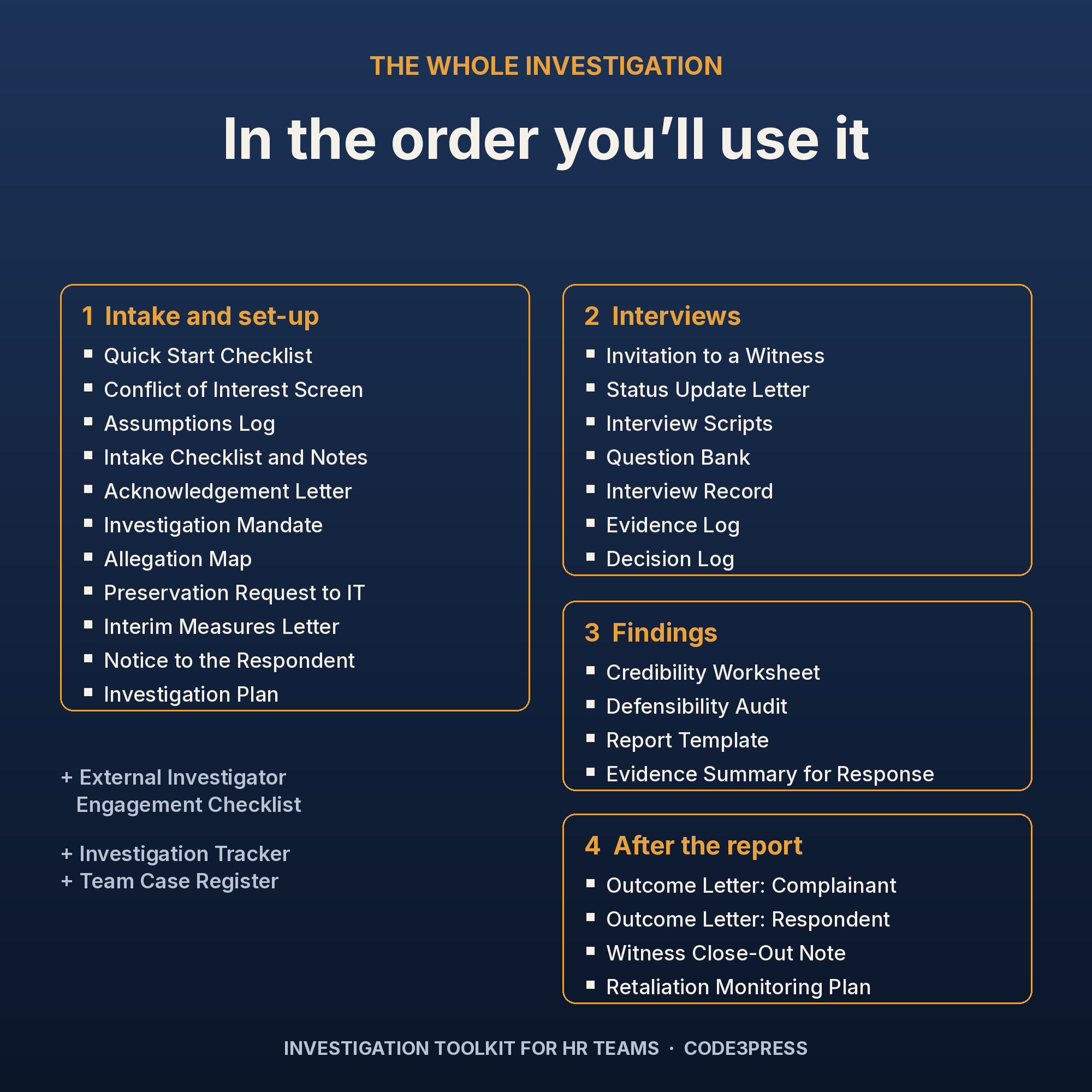
Every form, letter and tracker, in the order you'll use them.
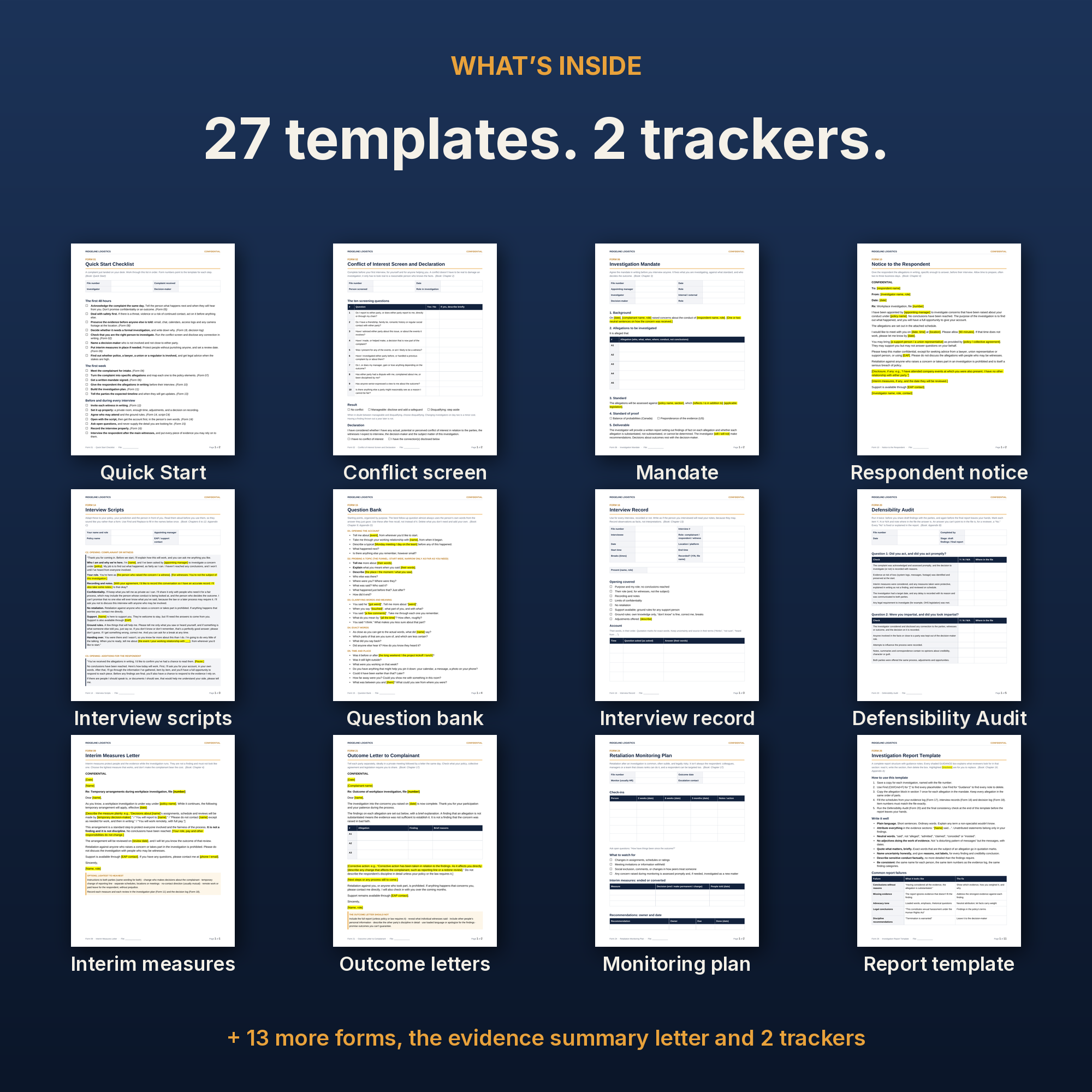
25 editable Word templates
Intake and set-up
Quick Start Checklist
Conflict of Interest Screen and Declaration
Assumptions Log
Intake Checklist and Notes
Acknowledgement Letter to Complainant
Investigation Mandate, with amendment log
Allegation Map
Preservation Request to IT
Interim Measures Letter
Notice to the Respondent, with schedule of allegations
Investigation Plan
Interviews
Invitation to a Witness
Status Update Letter
Interview Scripts: opening, getting the account, sensitive questions, putting evidence, distress, reluctant witnesses, confidentiality and closing
Question Bank, including "avoid this, ask this instead"
Interview Record
Evidence Log
Decision Log
Findings
Credibility Worksheet
Defensibility Audit
After the report
Outcome Letter to Complainant
Outcome Letter to Respondent
Witness Close-Out Note
Retaliation Monitoring Plan
Outside help
External Investigator Engagement Checklist
How it works in a real investigation
What your next investigation looks like with the toolkit.
Day one: the complaint lands. Open the Quick Start Checklist. Send the preservation request to IT before anyone is told, run the conflict screen, and send the acknowledgement letter the same day. Each one takes minutes because the wording is already written.
The first week: set it up properly. Turn the complaint into specific allegations on the mandate, map each allegation to its policy elements, and send the respondent written notice. Your investigation plan shows who to interview, in what order, and why.
Interviews: get accounts that hold up. Invite each witness in writing. Open with the script, get the full account first, then use the question bank to probe without leading. The interview record captures it the way a reviewer expects to see it.
Throughout: keep the file in order. Log every item of evidence and every significant decision as you go. The tracker shows what's open, what's overdue and what hasn't yet been put to the respondent.
Findings: show your reasoning. Work through the credibility worksheet for each disputed point, send each party the evidence relied on, and write the report section by section with the guidance notes beside you.
Before it goes out: audit it. Run the Defensibility Audit against your file. Every "no" is fixed or explained before the report leaves your hands.
After the report: close it properly. Send the outcome letters and witness notes, and put a retaliation monitoring plan in place with check-in dates.
The same steps, in the same order, for every investigation, and for every investigator on your team.
INVESTIGATION TOOLKIT FOR HR TEAMS
Every form, letter and tracker for a fair, defensible workplace investigation, from the first email to the final report.
You've read the method. Now run it the same way, every time.
When a harassment or misconduct complaint is challenged, reviewers don't just read your findings. They read your file: the mandate, the notices, the interview records, the evidence log, the decisions you made and why. Gaps in the file are where investigations fall apart.
The Investigation Toolkit for HR Teams gives you that whole file, ready to brand and use. It's the complete working kit for The HR Investigator's Interview Guide by Paul Clarke, built so your team can run every investigation the same way, step by step.
WHAT'S INCLUDED
25 editable Word templates, in the order you'll use them
Intake and set-up
• Quick Start Checklist
• Conflict of Interest Screen and Declaration
• Assumptions Log
• Intake Checklist and Notes
• Acknowledgement Letter to Complainant
• Investigation Mandate (with amendment log)
• Allegation Map
• Preservation Request to IT
• Interim Measures Letter
• Notice to the Respondent (with schedule of allegations)
• Investigation Plan Interviews
• Invitation to a Witness
• Status Update Letter
• Interview Scripts (opening, account, sensitive questions, putting evidence, distress, reluctant witnesses, confidentiality, closing)
• Question Bank, including "avoid this, ask this instead"
• Interview Record
• Evidence Log
• Decision Log
Findings
• Credibility Worksheet
• Defensibility Audit
After the report
• Outcome Letter to Complainant
• Outcome Letter to Respondent
• Witness Close-Out Note
• Retaliation Monitoring Plan
Outside help
• External Investigator Engagement Checklist
A full investigation report template, with guidance notes
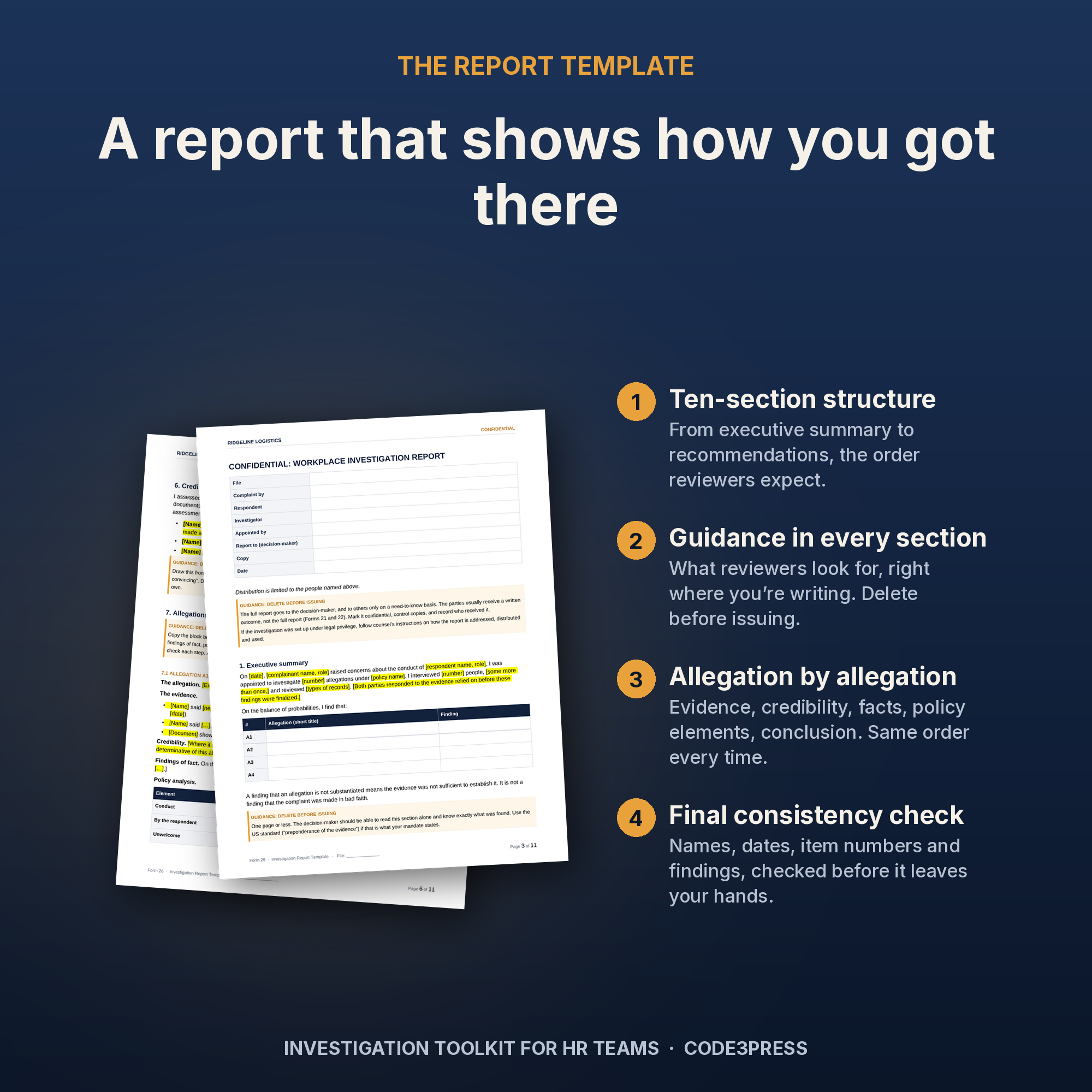
A ten-section report structure with a guidance note in every section explaining what reviewers look for. It includes an allegation-by-allegation block, a policy elements table, standard finding categories, schedules for interviews, evidence and chronology, and a final consistency check. Delete the guidance notes and the report is ready to issue.
Plus the Evidence Summary for Response letter, which gives each party the evidence relied on before findings are final.
Two Excel trackers
• Investigation Tracker (one per case): allegation map, evidence log, interviews, decisions, interim measures and party updates in one workbook. The Case Summary shows days open, days to your target date, overdue interim reviews, evidence not yet put to the respondent, and when the next party update is due.
• Team Case Register: one register and dashboard for every investigation your team runs.
BUILT FOR REAL USE
• Brand it once. Add your organization's name or logo to the header and save your own master copies.
• Fill in, don't start from scratch. Letters are pre-written in plain language. Every detail to replace is highlighted, so nothing gets missed.
• Every form shows its book chapter, so you can check the reasoning behind each step.
• Canada and the US. Wording and guidance cover both, including standards of proof and confidentiality instructions.
• Print-ready. Every template prints cleanly on letter paper.
WHO IT'S FOR
HR generalists and managers, employee relations specialists, people leaders who have been asked to investigate, and HR teams that want one consistent process for every investigator.
CHOOSE YOUR LICENCE
Individual license: for one investigator's use within their organization.
Team license: for everyone who conducts or supports investigations within one organization. (email for pricing)
Instant download: one zip file with a Start Here guide, 27 Word documents and 2 Excel workbooks.
FREQUENTLY ASKED QUESTIONS
Do I need the book?
The toolkit works on its own, and every form explains its purpose. The book explains the method behind each form in depth, with a full worked case and court decisions that show what reviewers look for. The two work best together.
How is this different from the free toolkit?
The free toolkit is a fillable PDF of 10 core forms and the Quick Start checklist. This toolkit gives you editable Word versions you can brand, 15 additional forms and letters covering the whole investigation, the full report template, and the trackers.
Can I change the templates?
Yes. Edit, brand and adapt them for investigations in your own organization. Please don't resell or share them outside your organization.
Is this legal advice?
No. These are general tools. Laws, policies and collective agreements differ by province and state and change over time. Adapt the templates to your situation and get advice from a qualified lawyer in your jurisdiction before relying on them in a specific case.