The Admissibility Funnel: The Only Checklist You Need to Secure a Confession—and Keep It Admissible.
Are you tired of crucial confessions being thrown out of court?
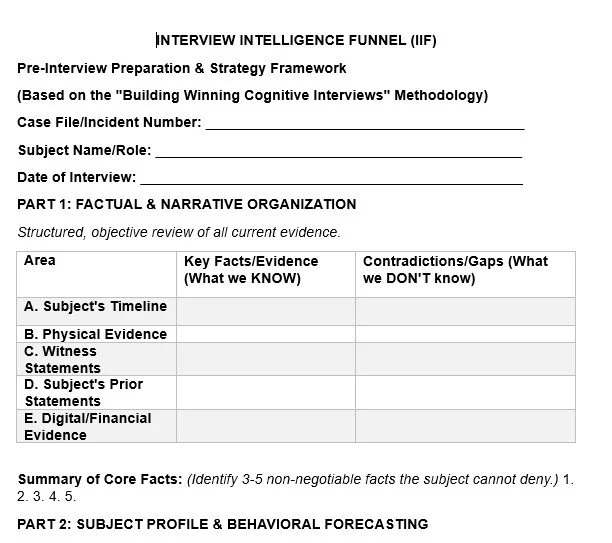
Canadian investigators are stuck between the ethical demands of modern interviewing and the legal risks of major crime interrogations. The Interview Intelligence Funnel Worksheet is the single most critical tool you can deploy in the interview room to bridge that gap.
This isn't just a checklist—it's a live-action blueprint that transforms your interview strategy from start to finish. It’s designed by a veteran Canadian police trainer to integrate psychological rapport-building with the mandatory legal checks required by the Supreme Court of Canada.
Inside, You Get:
The Guilty Knowledge Filter: Stop accidentally contaminating your investigation. Use the preparation sheet to identify and protect Non-Public Facts (NP-Facts)—the key evidence only the perpetrator and police know—ensuring your final confession is independently corroborated.
The 12-Phase Execution Blueprint: A step-by-step checklist that guides you from initial rapport (Phase 1) through strategic Theme Deployment (Phase 7) to securing the full narrative (Phase 10).
The Legal Firewalls:MANDATORY SCRIPTS built right into the execution plan. Deploy the Oickle Firewall to protect against involuntariness claims, and the Singh Re-Affirmation to legally consolidate the suspect's choice to speak.
Pre-Interview Handoff: Ensure every member of your team is prepared by pre-selecting Primary and Secondary Themes, defining the suspect’s Denial Pathway, and preparing the final consolidation language.
Stop leaving your case admissibility up to chance. The courts demand a documented, professional process. The Interview Intelligence Funnel gives you that process, ensuring your hard-won confession stands up to any judicial challenge.
Secure. Document. Admissible. Get the Funnel.
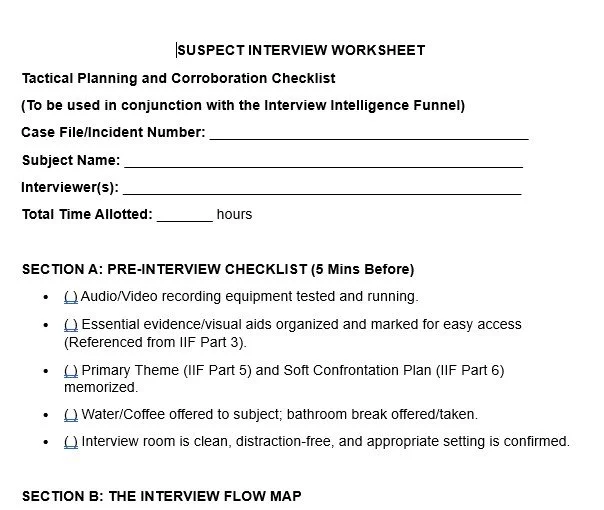
Structure is your best leverage. The Suspect Interview Worksheet is a tactical planning and execution document designed to keep you organized during high-pressure interviews.
This fillable tool works in tandem with the Interview Intelligence Funnel, guiding you through four critical phases:
Preparation Checklist: Confirm logistics, recording, and evidence before you begin.
Flow Map: Plan your rapport, open-ended questioning, and cognitive techniques.
Pressure Point Tracking: Monitor behavioral cues and log your theme pivots in real-time.
Evidence Gradient & Corroboration: Strategically deploy evidence and lock down post-admission details like intent, method, and timeline.
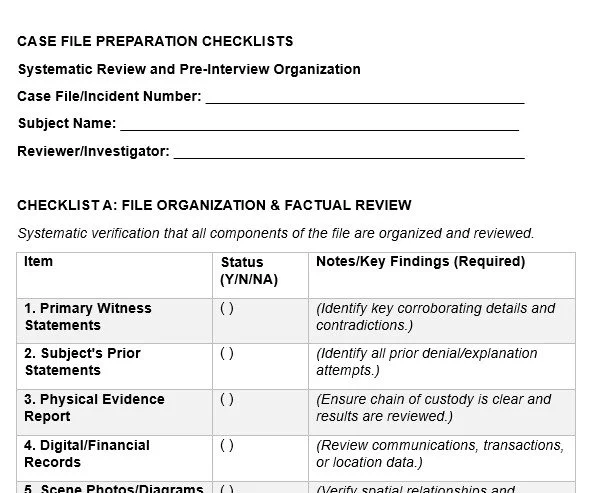
Effective interviewing requires absolute mastery of the case facts. The Case File Preparation Checklists are designed to guide investigators through a systematic review of all available intelligence.
Designed to integrate with the Suspect Interview Worksheet and Interview Intelligence Funnel, this document categorizes your review into four essential pillars:
File Organization: Confirm legal admissibility and identify key corroborating details in witness statements.
Timeline Lockdown: Review video and audio sources to establish a definitive sequence of events.
Injury Assessment: Analyze medical evidence to understand the Mechanism of Injury (MOI) and test suspect narratives regarding defensive vs. offensive wounds.
Pressure Point Preparation: Map out "Fact vs. Statement" contradictions to prepare your theme pivots.
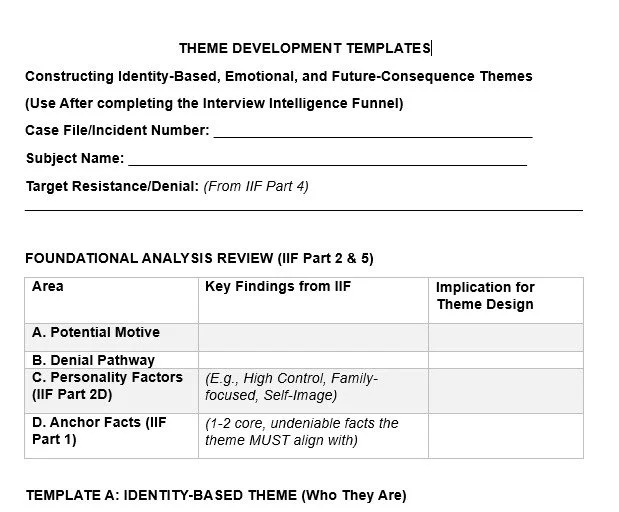
This download provides three distinct, fillable frameworks to craft themes that reduce resistance and lower the barrier to admission:
Template A: Identity-Based Themes (The "Who They Are" Approach) Learn to separate the suspect’s core identity from their regretful behavior. This template helps you identify positive traits (e.g., "Good Parent," "Hard Worker") and craft a "pivot phrase" that allows the subject to save face while admitting guilt.
Template B: Emotional & Responsibility-Shift Themes (The "Why It Happened" Approach) Stop asking "did you do it" and start asking "what pressure were you under?" This template helps you connect a primary emotion (fear, anger, desperation) to an external pressure factor, creating a narrative bridge that makes the action understandable—without excusing it.
Template C: Future-Consequence Themes (The "What Happens Next" Approach) Move the suspect out of the past and into the reality of their future. This framework helps you clearly define the consequences of denial versus the mitigation of cooperation , empowering the subject to make an immediate, rational choice.
Why You Need This Tool: Every template includes a "Theme Test" checkpoint to ensure your script reduces shame and offers an ethical explanation before you ever step inside the interview room. Stop improvising your themes. Build them with precision
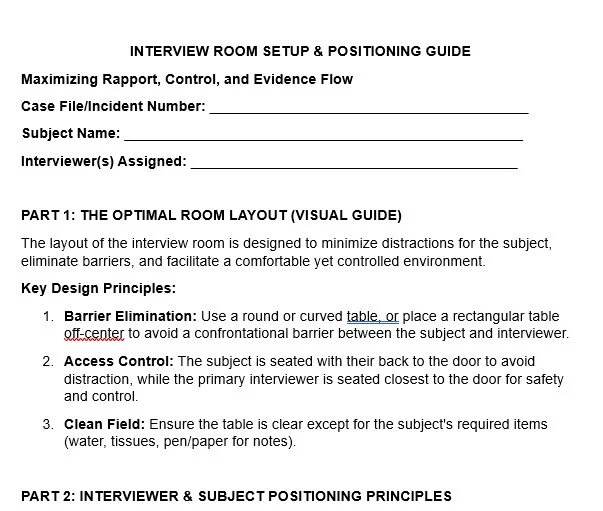
Consistency is the key to successful interviewing. This Interview Room Setup & Positioning Guide provides a standardized checklist to ensure every interview starts on the right footing.
Designed to complement the Interview Intelligence Funnel, this document breaks down the physical requirements of a professional interview into four actionable parts:
Room Layout: Visual principles for table selection and barrier removal.
Positioning: Strategic seating arrangements for Primary and Secondary interviewers to balance safety with rapport.
Material Management: Protocols for handling evidence folders, notes, and confession paperwork to prevent premature exposure.
AV Recording: A technical checklist for camera fields of view and microphone placement to ensure comprehensive legal documentation.
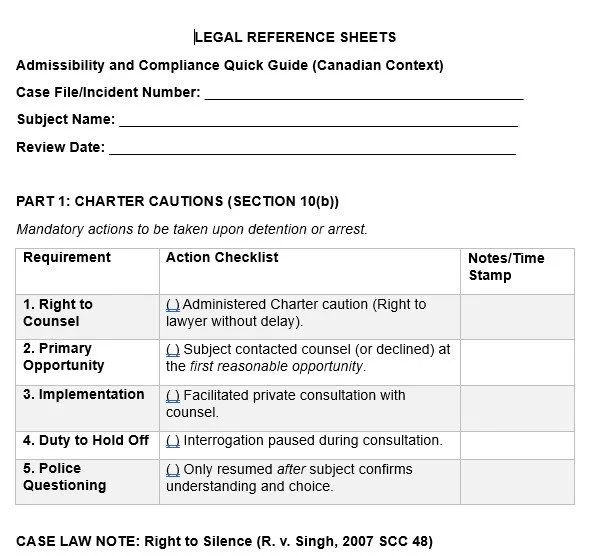
Investigative technique means nothing without legal integrity. The Legal Reference Sheets provide a concise summary of the case law governing police interviewing in Canada.
This document serves as a critical companion to the Suspect Interview Worksheet, translating high-level legal theory into operational rules. It covers:
Charter Obligations: Implementing the Right to Counsel and documenting the "First Reasonable Opportunity."
Voluntariness Factors: Understanding the boundaries set by R. v. Oickle regarding inducements and police trickery.
Tactical Limits: Recognizing fatal errors such as "shocking the conscience" or misusing pre-trial silence.
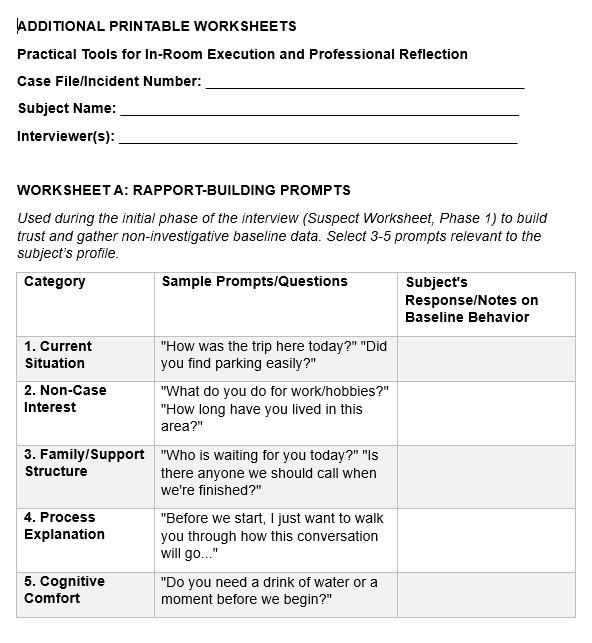
Great interviewers are made, not born. This collection of Additional Printable Worksheets provides the scaffolding for high-level execution and continuous professional improvement.
Designed to accompany the Suspect Interview Worksheet, these four documents focus on the nuances of human interaction and legal safety:
Rapport Builders: Establishing non-investigative baselines.
Denial Mapping: Tracking the battle between the suspect's lie and the investigator's theme.
Admission Security: Ensuring the transition from "I did it" to a legally binding statement is smooth and voluntary.
After-Action Review: A structured debriefing tool to capture lessons learned.
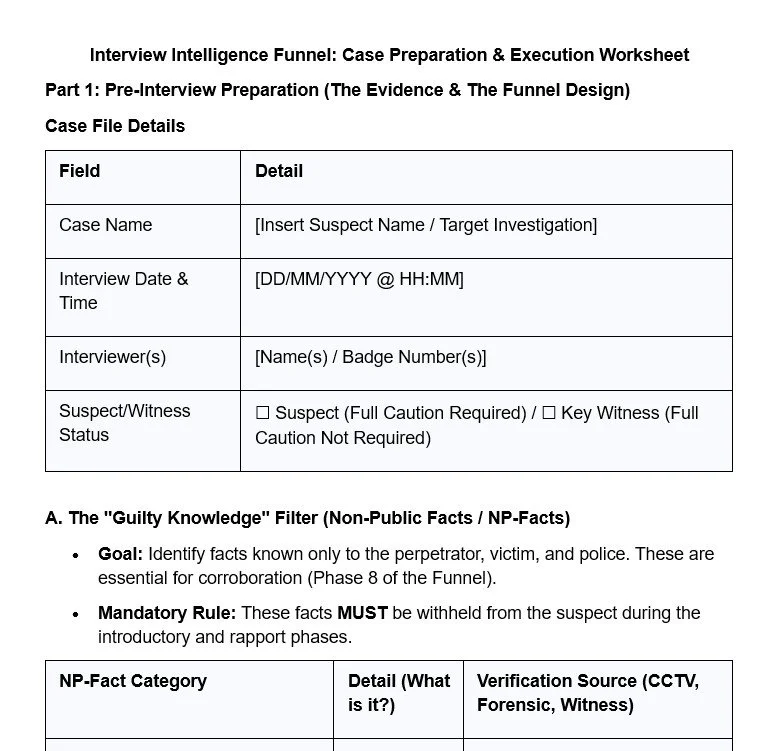
Admissibility is determined by process. This advanced worksheet provides a rigorous framework for planning and executing compliant, effective custodial interviews.
Designed for senior investigators and major crime units, this document moves beyond basic planning into legal defensibility and evidence management. It includes:
Pre-Interview Intel: A structured system for filtering "Guilty Knowledge" (Non-Public Facts) to protect the integrity of the confession.
Execution Roadmap: A detailed 12-phase checklist ensuring every procedural step—from the Charter Caution to the Oickle Firewall—is documented in real-time.
Legal Safety Nets: Mandatory scripting for handling Right to Silence assertions and confirming Voluntariness post-admission.
Post-Interview Audit: A quick-review section to verify corroboration and determine next investigative steps.