The transition from patrol officer to supervisor is one of the most disorienting moves in a law enforcement career. You spent years building instincts for one job. Then you were promoted into a completely different one — and given almost no structured preparation for it.
The Leadership Operating System is the field guide that fills that gap. Built from 23 years of law enforcement experience, it gives you a complete set of practical tools for every dimension of supervisory leadership: who you are before you walk in the door, how you run the hard conversations, how you build a unit culture rather than inherit one, how you lead your officers through critical incidents and what comes after, and how you protect your own capacity to lead across a full career.
Every tool is self-contained. You do not need to read the full system before you use any part of it. Open any phase on any day and deploy it before your next shift.
Phase 1 — Foundation: Command Presence
Who you are before you walk in the door determines what your officers experience before you say a word. Phase 1 builds the internal standard that precedes everything else.
Tools included: Leadership Fitness Inventory · Leadership Values Map · Supervisor Identity Statement · New Supervisor 90-Day Identity Checklist · The Inner Briefing Card · Commander's Mindset Protocol
The Leadership Fitness Inventory is your honest baseline — 28 specific statements across Command Presence, Team Climate, Stress Management, and Legacy. Complete it before anything else. Retake it every 90 days. The trajectory across three inventories is more useful than any single score.
The Inner Briefing Card is the anchor practice: five minutes in your vehicle before every shift, every day, without exception. The laminate-ready version is included as a standalone appendix — print it, laminate it, keep it on your dashboard.
Phase 2 — Team Environment: Feedback and Performance
Phase 2 gives you the exact language for the conversations most supervisors delay for weeks — because they don't have a structure for them and don't want to damage the relationship.
Tools included: W.I.N. Supervisor Application Guide · Supervisor State Reset Guide · Positive Feedback Protocol · Feedback Conversation Scripts (5 scenarios) · Debrief Question Replacement Guide · Performance Improvement Conversation Guide
The Feedback Conversation Scripts cover five of the most common situations you will face — file documentation drifting, tone escalating on calls, an experienced officer whose performance has declined, an attendance pattern, and a scenario that deserves recognition rather than correction. Each script includes the opening line, the observation language, the impact framing, the commitment, and the closing. Read the one you need the night before. Walk in with it.
The Performance Improvement Conversation Guide covers the transition point between developmental feedback and formal performance management — including when to make the move, how to prepare, and the exact language for the conversation that most supervisors find hardest to have.
Phase 3 — Cultural Engineering: Building What You Want
Culture is not what a supervisor says it is. It is what a supervisor tolerates, models, and rewards — consistently, over time. Phase 3 makes that deliberate.
Tools included: Culture Conversation Facilitation Guide · Safety Signal 30-Day Challenge · Monthly Team Climate Debrief
The quarterly Culture Conversation is 20 minutes, two questions, and a rule: the supervisor goes last. The answers tell you what your unit wants to protect and what it needs to change — from the people who know it best.
The Safety Signal 30-Day Challenge gives you one concrete psychological safety action per day across four weekly themes: Modelling, Rewarding, Protecting, and Repairing. The rule is that every signal must be genuine. Performed psychological safety is worse than none.
Phase 4 — Critical Incident and Wellness: Human First, Then Process
When a critical incident involves your officers, the operational follow-up almost always happens. The human follow-up needs a structure too — and a timeline.
Tools included: Critical Incident Command Checklist · Individual Check-In Scripts (72-hour window) · Officer Wellness Check-In Protocol with career stage question sets
The Critical Incident Command Checklist runs in three phases: immediate command on scene, the human transition before notifications, and the 6–72 hour individual check-in window. The check-in scripts give you the exact language for Hours 6–24, 24–48, and 48–72. Three questions per check-in. The change between check-ins is the data.
The Officer Wellness Check-In Protocol is the standing monthly practice — two questions, per officer, private, 20 minutes. The career stage question sets give you deeper language for Years 1–5, Years 6–15, and Years 16–25+, because what an officer needs to be asked changes across a career.
Phase 5 — Legacy and Sustainability: Protecting Your Capacity to Lead
A supervisor who burns out doesn't go quietly — they erode. The unit inherits the cynicism, the withdrawal, the diminished standard. Phase 5 makes sustainability structural.
Tools included: Supervisor Burnout Inventory · Evidence File · Leadership Resilience 90-Day Maintenance Plan
The Burnout Inventory measures four specific dimensions — Emotional Exhaustion, Depersonalisation, Reduced Accomplishment, and Role Erosion — with 28 statements and benchmark scores per dimension. Run it every 90 days alongside the Leadership Fitness Inventory. The gap between your baseline score and your 90-day score is your measurable growth.
The Evidence File is the deliberate counter to the impostor narrative: a running log of specific moments where you led the way this system describes. One entry per week. Read the full file monthly. The pattern across entries tells you more about the supervisor you are becoming than any single performance review.
Who this is for: Law enforcement supervisors at any career stage — new to the role and needing a system fast, or experienced and looking to rebuild a practice that has drifted. Also used by agency training coordinators as a structured supervisory development resource.
Relevant for municipal police, RCMP, sheriff's offices, corrections, and other law enforcement supervisory roles across Canada and the United States.
Format: Instant PDF download, delivered to your email immediately after purchase. Designed for print — use it as a physical workbook with the included write-in fields, or read digitally on a tablet. The Inner Briefing Card laminate is formatted as a standalone page ready to print and cut.
From the author: Paul Clarke spent 23 years in law enforcement. He is the founder of Code3Press and the author of The Defendable Report Series. The Leadership Operating System is built on what he observed supervisors actually need — not what leadership training theory says they should need. Every tool came from a real gap he saw in the field.
Agency and institutional licensing available. If you are a training coordinator evaluating this resource for your service, contact Code3Press directly for a complimentary evaluation copy and bulk pricing.
The transition from patrol officer to supervisor is one of the most disorienting moves in a law enforcement career. You spent years building instincts for one job. Then you were promoted into a completely different one — and given almost no structured preparation for it.
The Leadership Operating System is the field guide that fills that gap. Built from 23 years of law enforcement experience, it gives you a complete set of practical tools for every dimension of supervisory leadership: who you are before you walk in the door, how you run the hard conversations, how you build a unit culture rather than inherit one, how you lead your officers through critical incidents and what comes after, and how you protect your own capacity to lead across a full career.
Every tool is self-contained. You do not need to read the full system before you use any part of it. Open any phase on any day and deploy it before your next shift.
Phase 1 — Foundation: Command Presence
Who you are before you walk in the door determines what your officers experience before you say a word. Phase 1 builds the internal standard that precedes everything else.
Tools included: Leadership Fitness Inventory · Leadership Values Map · Supervisor Identity Statement · New Supervisor 90-Day Identity Checklist · The Inner Briefing Card · Commander's Mindset Protocol
The Leadership Fitness Inventory is your honest baseline — 28 specific statements across Command Presence, Team Climate, Stress Management, and Legacy. Complete it before anything else. Retake it every 90 days. The trajectory across three inventories is more useful than any single score.
The Inner Briefing Card is the anchor practice: five minutes in your vehicle before every shift, every day, without exception. The laminate-ready version is included as a standalone appendix — print it, laminate it, keep it on your dashboard.
Phase 2 — Team Environment: Feedback and Performance
Phase 2 gives you the exact language for the conversations most supervisors delay for weeks — because they don't have a structure for them and don't want to damage the relationship.
Tools included: W.I.N. Supervisor Application Guide · Supervisor State Reset Guide · Positive Feedback Protocol · Feedback Conversation Scripts (5 scenarios) · Debrief Question Replacement Guide · Performance Improvement Conversation Guide
The Feedback Conversation Scripts cover five of the most common situations you will face — file documentation drifting, tone escalating on calls, an experienced officer whose performance has declined, an attendance pattern, and a scenario that deserves recognition rather than correction. Each script includes the opening line, the observation language, the impact framing, the commitment, and the closing. Read the one you need the night before. Walk in with it.
The Performance Improvement Conversation Guide covers the transition point between developmental feedback and formal performance management — including when to make the move, how to prepare, and the exact language for the conversation that most supervisors find hardest to have.
Phase 3 — Cultural Engineering: Building What You Want
Culture is not what a supervisor says it is. It is what a supervisor tolerates, models, and rewards — consistently, over time. Phase 3 makes that deliberate.
Tools included: Culture Conversation Facilitation Guide · Safety Signal 30-Day Challenge · Monthly Team Climate Debrief
The quarterly Culture Conversation is 20 minutes, two questions, and a rule: the supervisor goes last. The answers tell you what your unit wants to protect and what it needs to change — from the people who know it best.
The Safety Signal 30-Day Challenge gives you one concrete psychological safety action per day across four weekly themes: Modelling, Rewarding, Protecting, and Repairing. The rule is that every signal must be genuine. Performed psychological safety is worse than none.
Phase 4 — Critical Incident and Wellness: Human First, Then Process
When a critical incident involves your officers, the operational follow-up almost always happens. The human follow-up needs a structure too — and a timeline.
Tools included: Critical Incident Command Checklist · Individual Check-In Scripts (72-hour window) · Officer Wellness Check-In Protocol with career stage question sets
The Critical Incident Command Checklist runs in three phases: immediate command on scene, the human transition before notifications, and the 6–72 hour individual check-in window. The check-in scripts give you the exact language for Hours 6–24, 24–48, and 48–72. Three questions per check-in. The change between check-ins is the data.
The Officer Wellness Check-In Protocol is the standing monthly practice — two questions, per officer, private, 20 minutes. The career stage question sets give you deeper language for Years 1–5, Years 6–15, and Years 16–25+, because what an officer needs to be asked changes across a career.
Phase 5 — Legacy and Sustainability: Protecting Your Capacity to Lead
A supervisor who burns out doesn't go quietly — they erode. The unit inherits the cynicism, the withdrawal, the diminished standard. Phase 5 makes sustainability structural.
Tools included: Supervisor Burnout Inventory · Evidence File · Leadership Resilience 90-Day Maintenance Plan
The Burnout Inventory measures four specific dimensions — Emotional Exhaustion, Depersonalisation, Reduced Accomplishment, and Role Erosion — with 28 statements and benchmark scores per dimension. Run it every 90 days alongside the Leadership Fitness Inventory. The gap between your baseline score and your 90-day score is your measurable growth.
The Evidence File is the deliberate counter to the impostor narrative: a running log of specific moments where you led the way this system describes. One entry per week. Read the full file monthly. The pattern across entries tells you more about the supervisor you are becoming than any single performance review.
Who this is for: Law enforcement supervisors at any career stage — new to the role and needing a system fast, or experienced and looking to rebuild a practice that has drifted. Also used by agency training coordinators as a structured supervisory development resource.
Relevant for municipal police, RCMP, sheriff's offices, corrections, and other law enforcement supervisory roles across Canada and the United States.
Format: Instant PDF download, delivered to your email immediately after purchase. Designed for print — use it as a physical workbook with the included write-in fields, or read digitally on a tablet. The Inner Briefing Card laminate is formatted as a standalone page ready to print and cut.
From the author: Paul Clarke spent 23 years in law enforcement. He is the founder of Code3Press and the author of The Defendable Report Series. The Leadership Operating System is built on what he observed supervisors actually need — not what leadership training theory says they should need. Every tool came from a real gap he saw in the field.
Agency and institutional licensing available. If you are a training coordinator evaluating this resource for your service, contact Code3Press directly for a complimentary evaluation copy and bulk pricing.

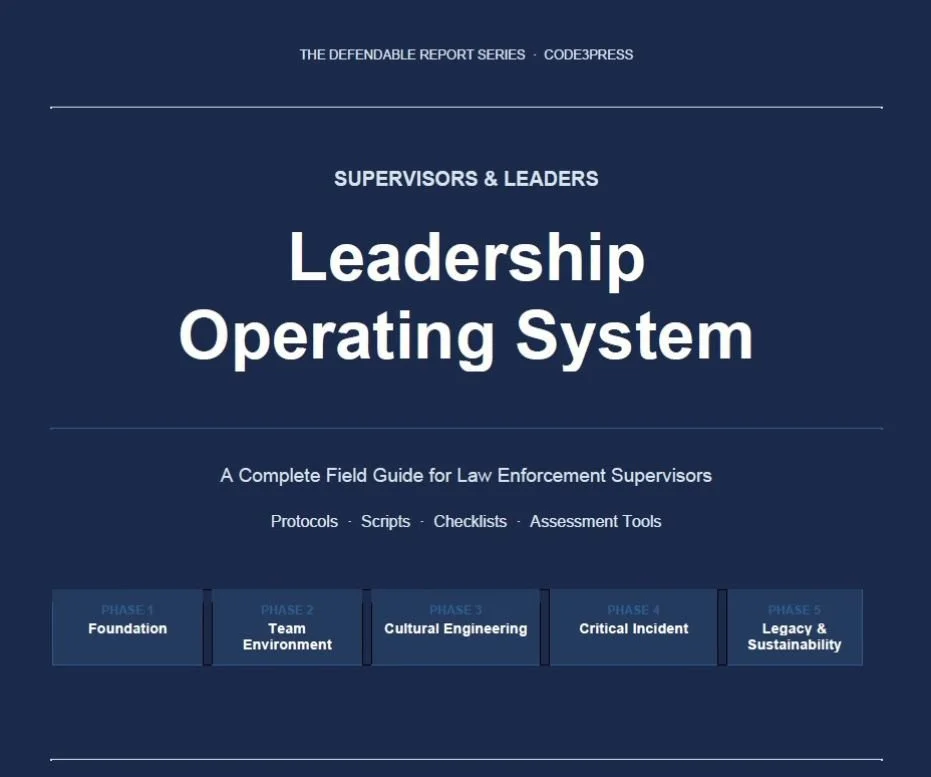 Image 1 of 8
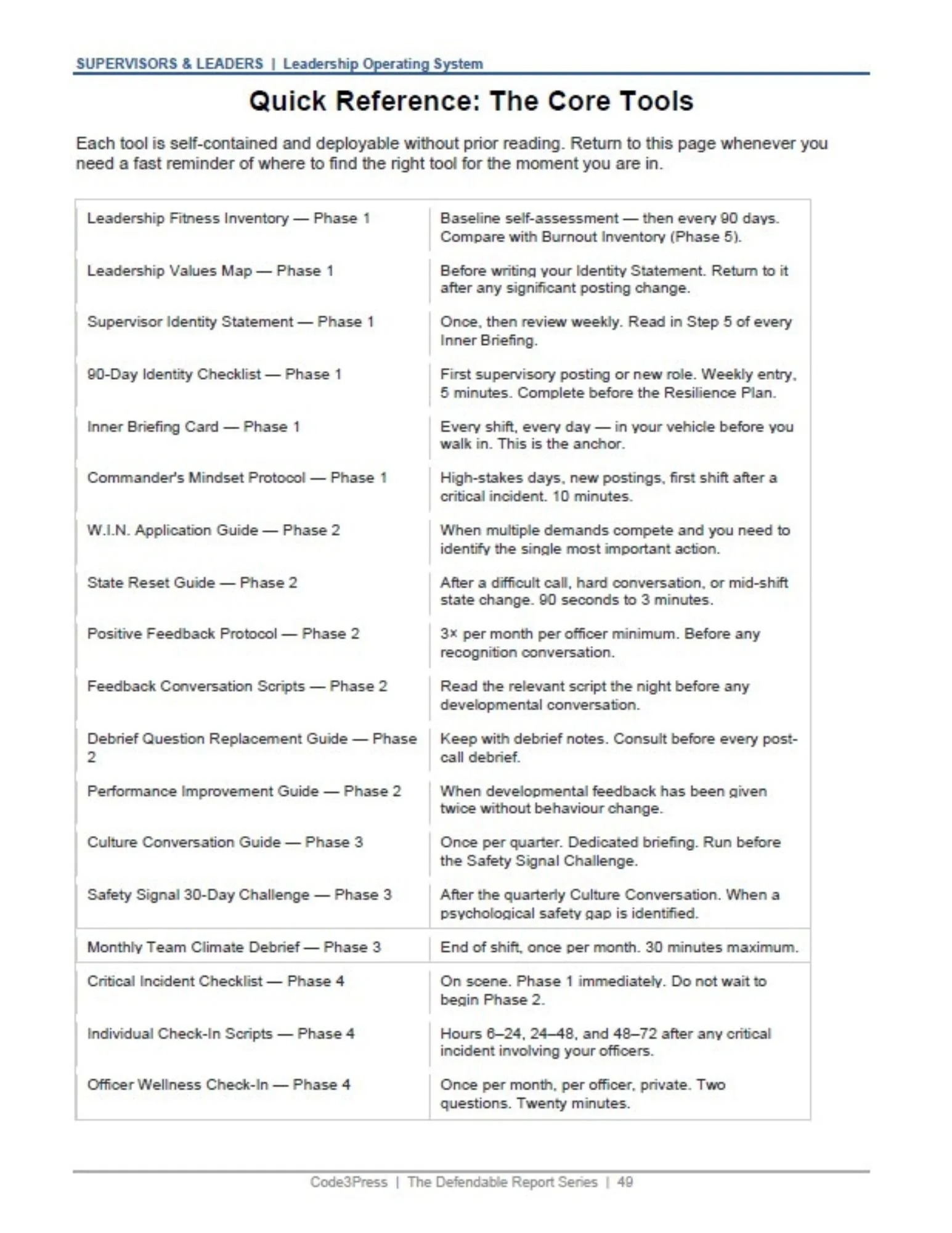 Image 2 of 8
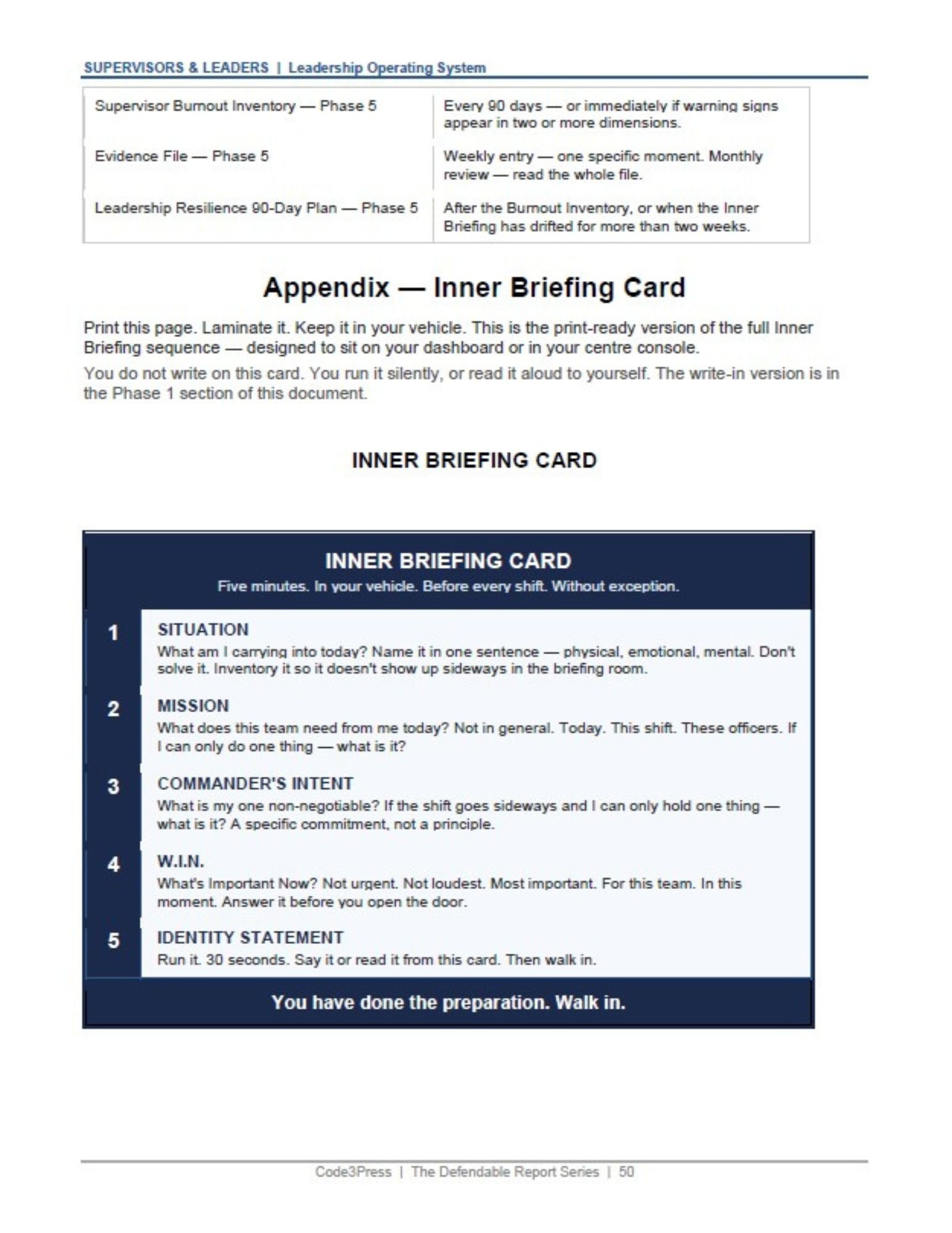 Image 3 of 8
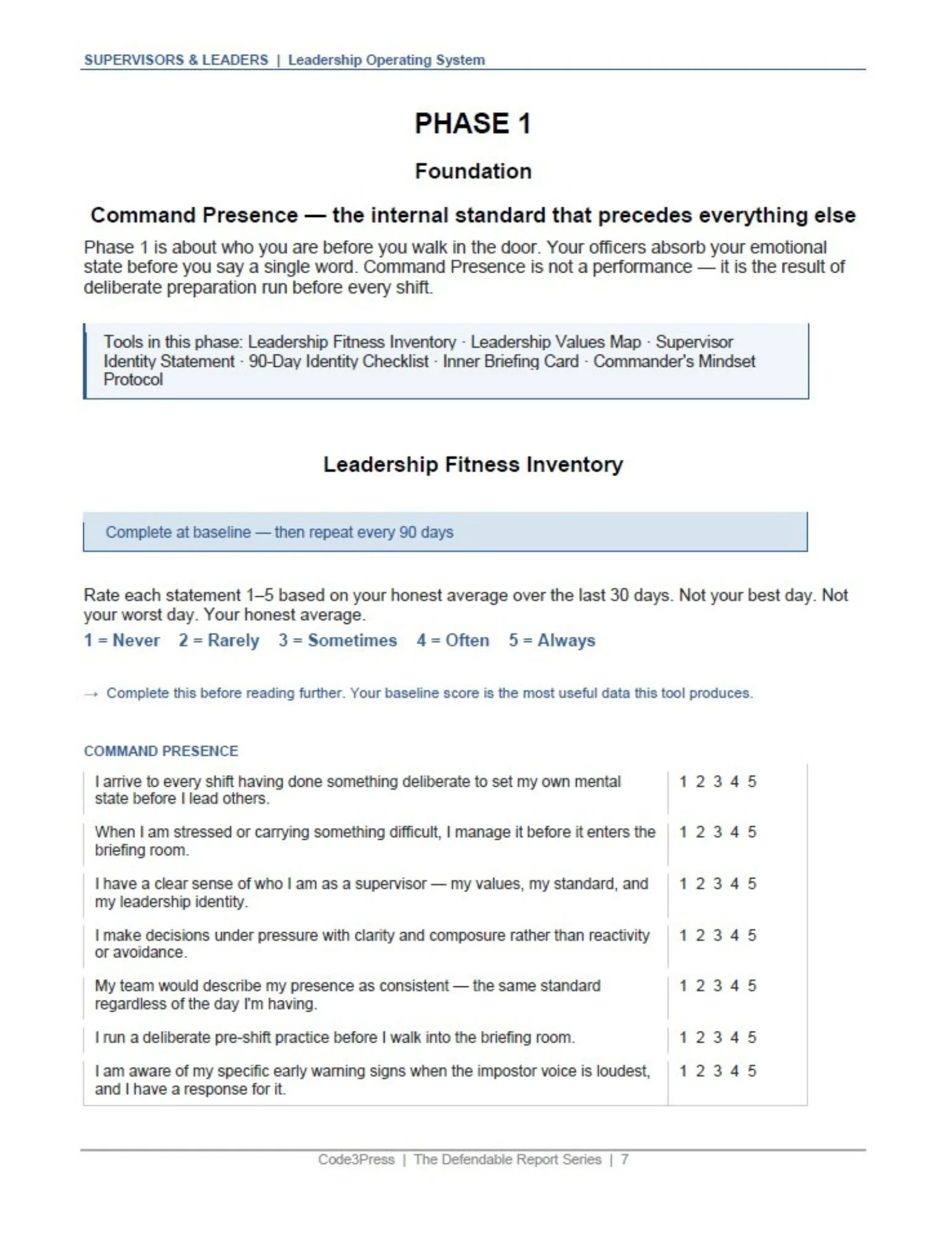 Image 4 of 8
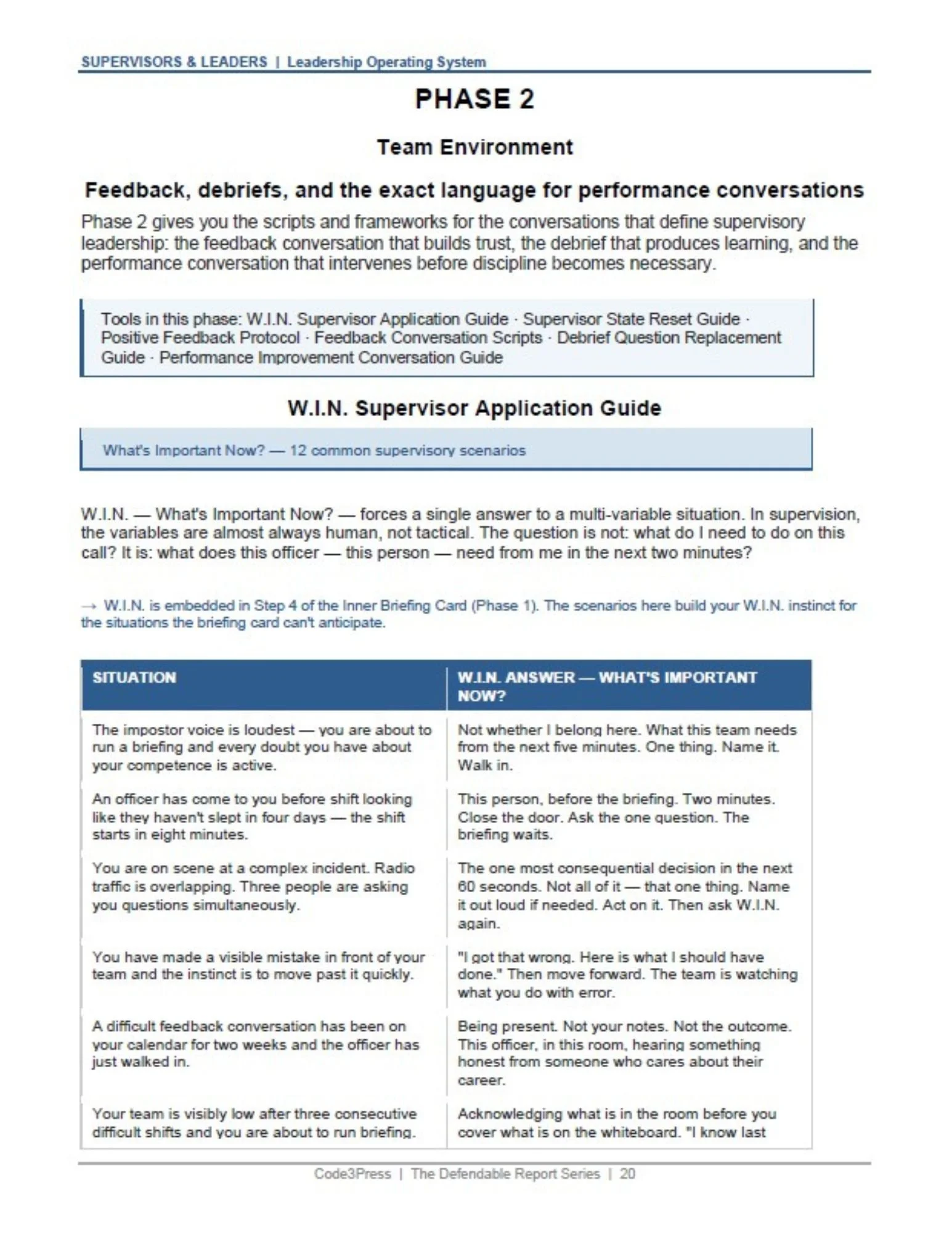 Image 5 of 8
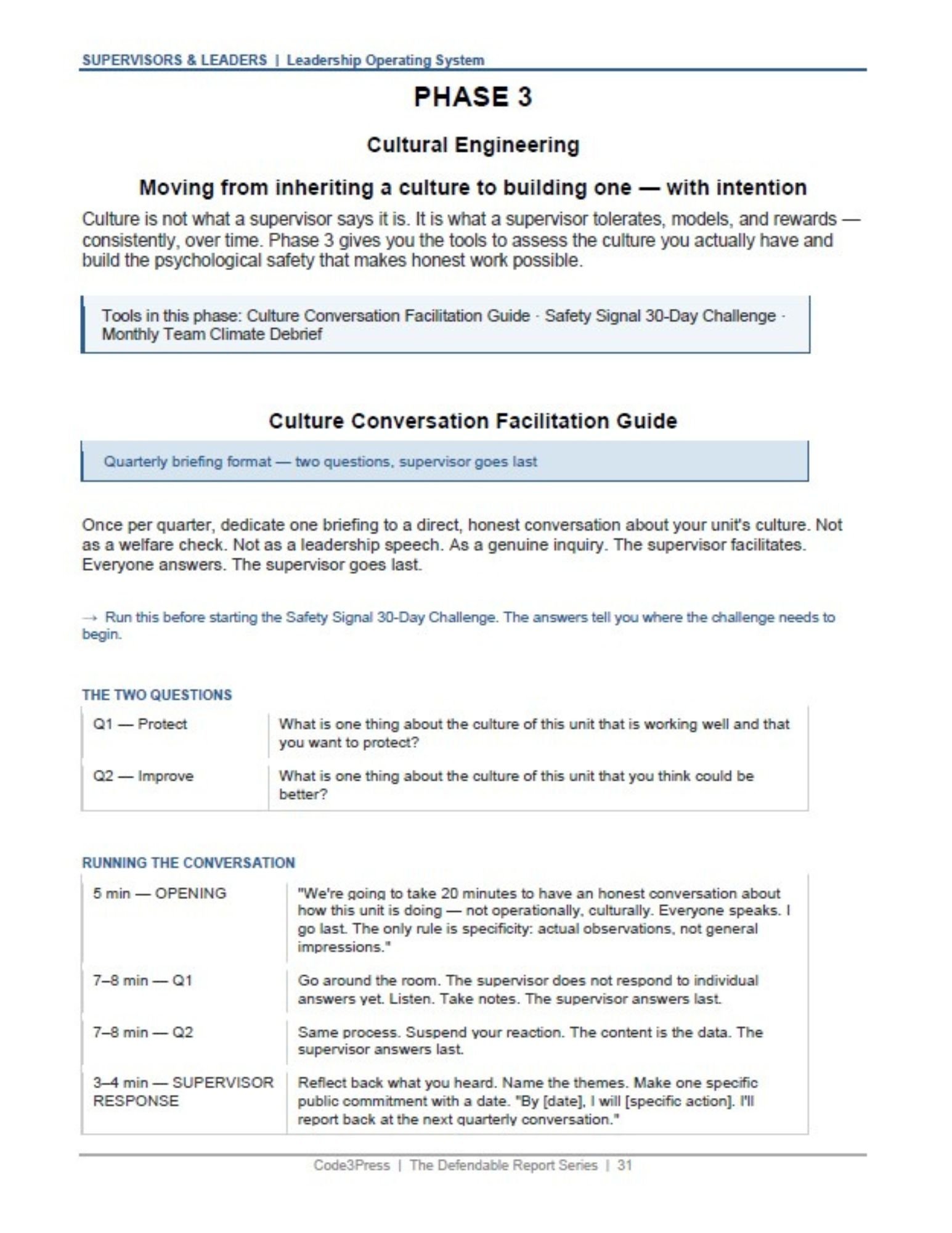 Image 6 of 8
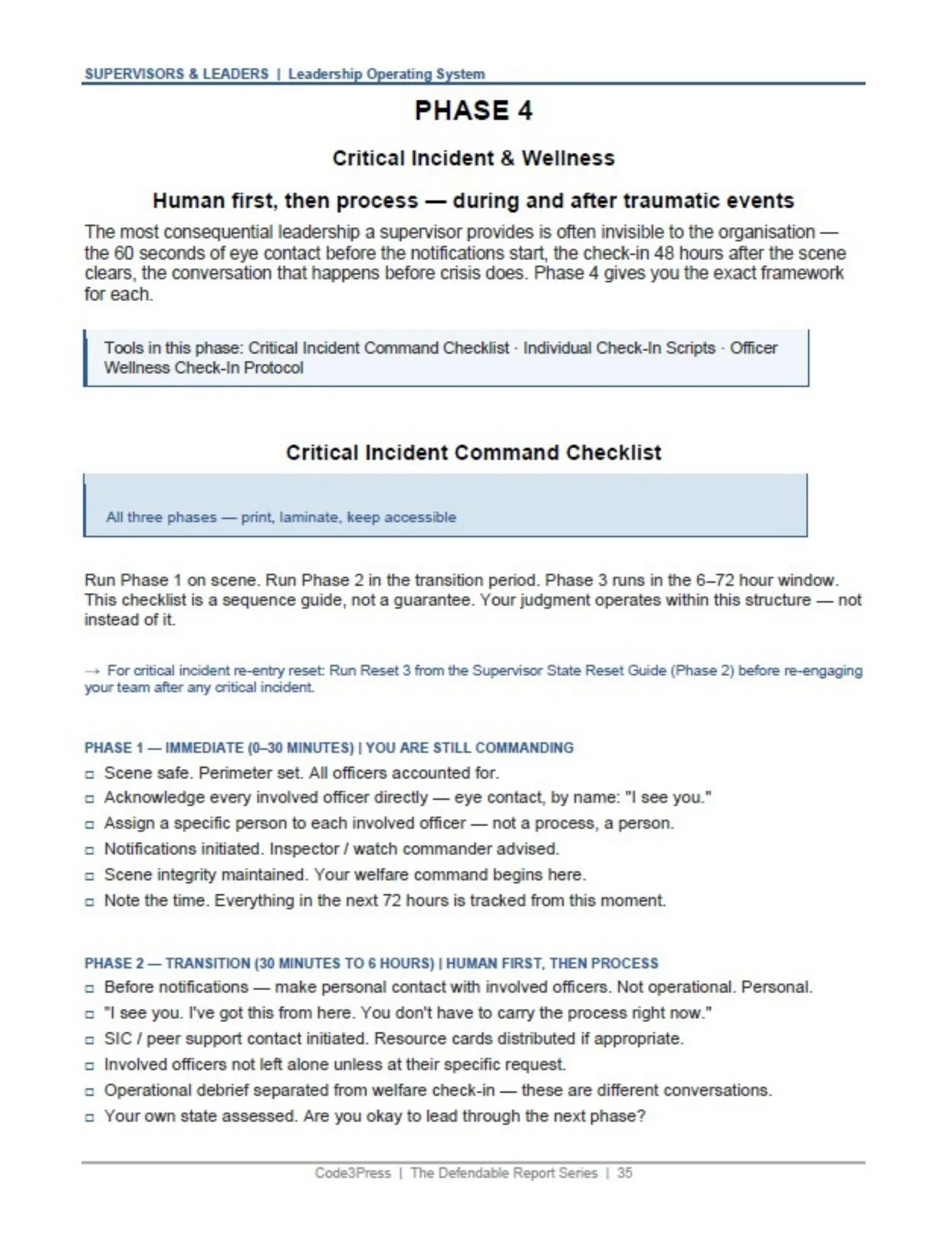 Image 7 of 8
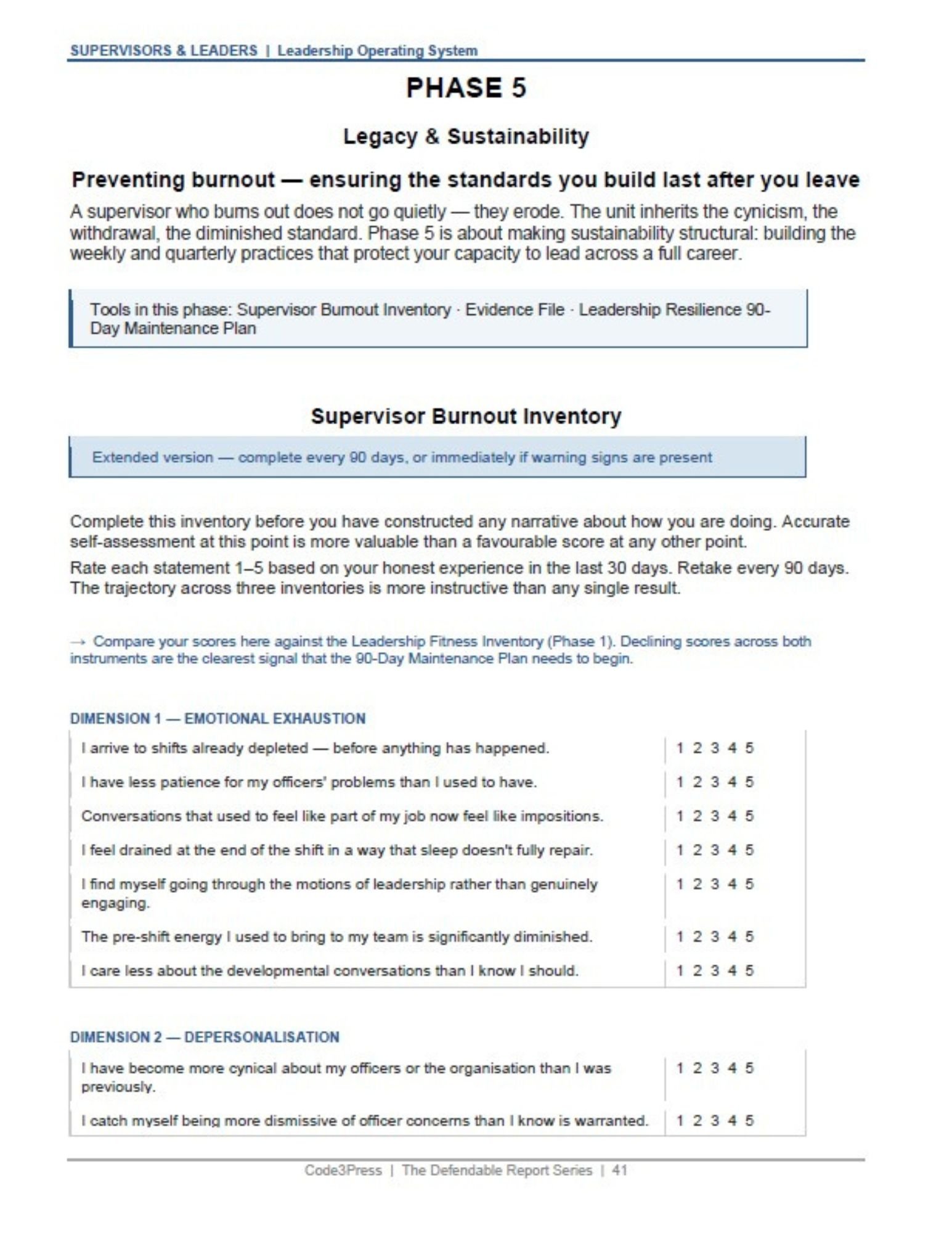 Image 8 of 8