 Image 1 of 1
The conversation most supervisors walk into unprepared.
Every supervisor eventually gives feedback they wish they'd planned better.
They go in with good intentions and a general sense of what the problem is. They come out having said something vague, gotten a defensive reaction, and created no documented record of what was agreed. Three months later, the behaviour hasn't changed — and the member's response to any formal action is that this is the first they've heard of it.
The Feedback Conversation Planning Guide stops that from happening.
This is Template 9 from The Defendable Supervisor — a 22-template field system built specifically for law enforcement supervisors. Template 9 is the one supervisors reach for most.
What the template does
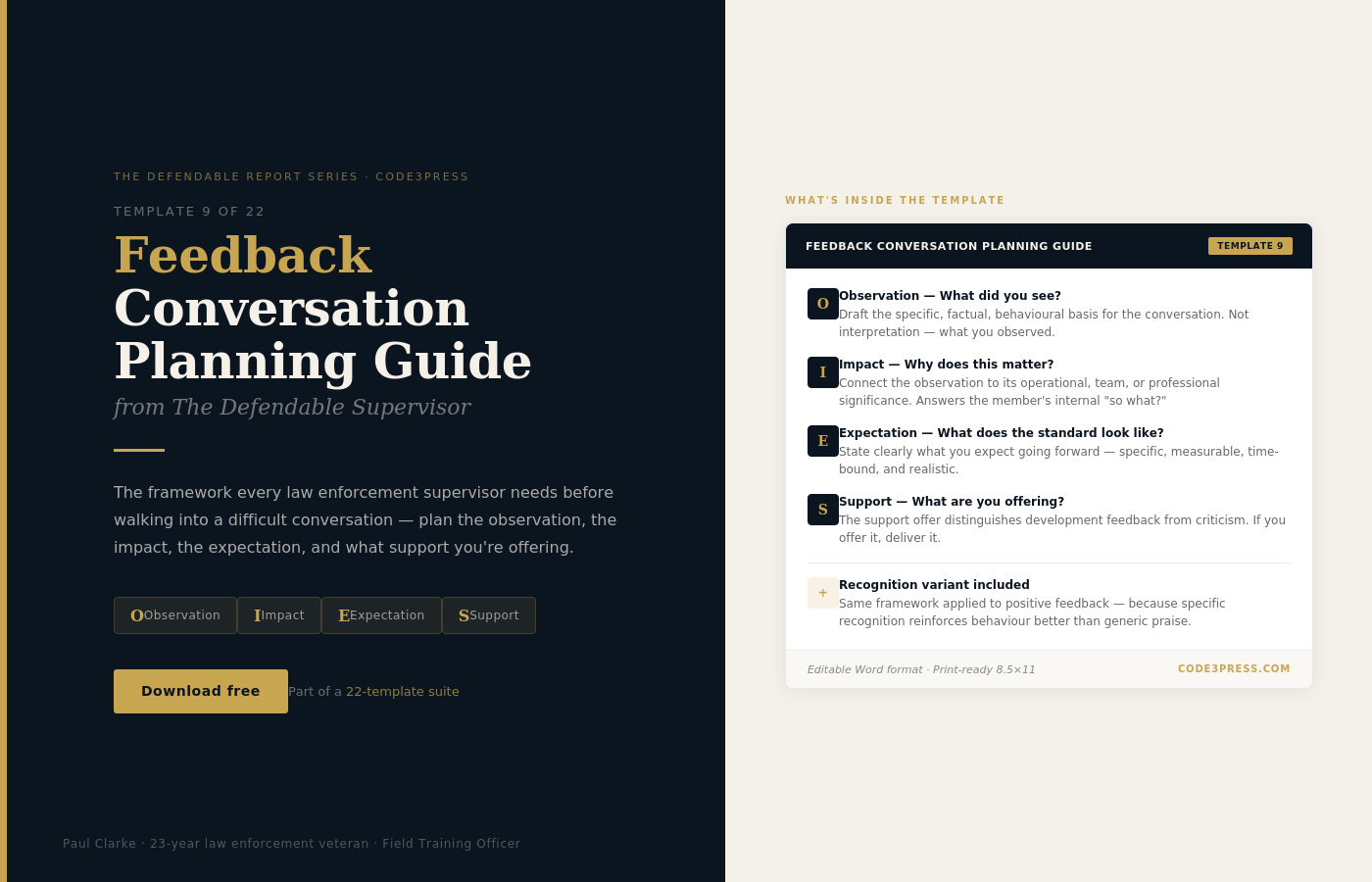
It walks you through the O.I.E.S. feedback framework — four steps that separate feedback that actually changes behaviour from feedback that is merely delivered:
Observation — what exactly did you see? Not your interpretation, not a character judgment. A specific, factual, behavioural account that is challengeable on the facts — not on your opinion.
Impact — why does it matter? The member will ask themselves so what? — this step answers it before they have to. Operational consequences, team consequences, professional consequences. Feedback without impact is just criticism.
Expectation — what does the standard look like going forward? Specific enough that both parties could agree, at a future date, on whether it was met. Not "do better." A target.
Support — what are you offering to help them get there? The support offer is what distinguishes development feedback from discipline. It signals you are invested in the member's success — not just documenting their failures.
The guide also includes planning space for your opening line, your closing, and what you'll do if the conversation goes sideways — because the supervisor who has a plan for defensiveness handles it better than the one who doesn't.
There is also a recognition variant: the same specificity framework applied to positive feedback. Generic praise has minimal impact. This template shows you how to give recognition that actually reinforces the behaviour you want more of.
What you get
One fully editable Microsoft Word template, ready to print or complete on-screen before your next feedback conversation.
Works for any feedback scenario — from a coaching conversation about a specific behaviour to a formal performance discussion. The framework scales.
This is one template from a suite of 22.
The Defendable Supervisor Template Suite covers every major supervisory system — onboarding, one-on-ones, coaching, progressive discipline, incident command, and team wellness. Template 9 links directly to the Coaching Log (Template 8) and the Post-Conversation Documentation Template (Template 11) — because one conversation is only defensible when it sits inside a documented pattern.
If this template changes how a single conversation goes, the full suite gives you the complete system.
The conversation most supervisors walk into unprepared.
Every supervisor eventually gives feedback they wish they'd planned better.
They go in with good intentions and a general sense of what the problem is. They come out having said something vague, gotten a defensive reaction, and created no documented record of what was agreed. Three months later, the behaviour hasn't changed — and the member's response to any formal action is that this is the first they've heard of it.
The Feedback Conversation Planning Guide stops that from happening.
This is Template 9 from The Defendable Supervisor — a 22-template field system built specifically for law enforcement supervisors. Template 9 is the one supervisors reach for most.
What the template does
It walks you through the O.I.E.S. feedback framework — four steps that separate feedback that actually changes behaviour from feedback that is merely delivered:
Observation — what exactly did you see? Not your interpretation, not a character judgment. A specific, factual, behavioural account that is challengeable on the facts — not on your opinion.
Impact — why does it matter? The member will ask themselves so what? — this step answers it before they have to. Operational consequences, team consequences, professional consequences. Feedback without impact is just criticism.
Expectation — what does the standard look like going forward? Specific enough that both parties could agree, at a future date, on whether it was met. Not "do better." A target.
Support — what are you offering to help them get there? The support offer is what distinguishes development feedback from discipline. It signals you are invested in the member's success — not just documenting their failures.
The guide also includes planning space for your opening line, your closing, and what you'll do if the conversation goes sideways — because the supervisor who has a plan for defensiveness handles it better than the one who doesn't.
There is also a recognition variant: the same specificity framework applied to positive feedback. Generic praise has minimal impact. This template shows you how to give recognition that actually reinforces the behaviour you want more of.
What you get
One fully editable Microsoft Word template, ready to print or complete on-screen before your next feedback conversation.
Works for any feedback scenario — from a coaching conversation about a specific behaviour to a formal performance discussion. The framework scales.
This is one template from a suite of 22.
The Defendable Supervisor Template Suite covers every major supervisory system — onboarding, one-on-ones, coaching, progressive discipline, incident command, and team wellness. Template 9 links directly to the Coaching Log (Template 8) and the Post-Conversation Documentation Template (Template 11) — because one conversation is only defensible when it sits inside a documented pattern.
If this template changes how a single conversation goes, the full suite gives you the complete system.